1
Refer to the exhibit. Communication between two peers has
failed. Based on the output that is shown, what is the most likely
cause?
interface reset
unplugged cable
improper LMI type
PPP negotiation failure
2
Refer to the exhibit. A network administrator
is tasked with completing the Frame Relay topology that interconnects
two remote sites. How should the point-to-point subinterfaces be
configured on HQ to complete the topology?
frame-relay interface-dlci 103 on Serial 0/0/0.1
frame-relay interface-dlci 203 on Serial 0/0/0.2
frame-relay interface-dlci 301 on Serial 0/0/0.1
frame-relay interface-dlci 302 on Serial 0/0/0.2
frame-relay map ip 192.168.1.1 103 broadcast on Serial 0/0/0.1
frame-relay map ip 192.168.2.2 203 broadcast on Serial 0/0/0.2
frame-relay map ip 192.168.1.1 301 broadcast on Serial 0/0/0.1
frame-relay map ip 192.168.2.2 302 broadcast on Serial 0/0/0.2
3
Which data link layer encapsulation protocol is used by default for serial connections between two Cisco routers?
ATM
Frame Relay
HDLC
PPP
SDLC
4
Refer to the exhibit. Company ABC expanded its business and recently opened a new branch office in another country. IPv6 addresses
have been used for the company network. The data servers Server1 and
Server2 run applications which require end-to-end functionality, with
unmodified packets that are forwarded from the source to the
destination. The edge routers R1 and R2 support dual stack configuration. What solution should be deployed at the edge of the company network in order to successfully interconnect both offices?
a new WAN service supporting only IPv6
NAT overload to map inside IPv6 addresses to outside IPv4 address
a manually configured IPv6 tunnel between the edge routers R1 and R2
static NAT to map inside IPv6 addresses of the servers to an outside IPv4 address and dynamic NAT for the rest of the inside IPv6 addresses
5
Which variable is permitted or denied by a standard access control list?
protocol type
source IP address
source MAC address
destination IP address
destination MAC address
6
Refer to the exhibit. The link between the CTRL and BR_1 routers is configured as shown in the exhibit. Why are the routers unable to establish a PPP session?
The clock rate must be 56000.
The usernames are misconfigured.
The IP addresses are on different subnets.
The clock rate is configured on the wrong end of the link.
The CHAP passwords must be different on the two routers.
Interface serial 0/0/0 on CTRL must connect to interface serial 0/0/1 on BR_1.
7
Which three statements accurately describe a security policy? (Choose three.)
It creates a basis for legal action if necessary.
It defines a process for managing security violations.
It defines acceptable and unacceptable use of network resources.
The remote access policy is a component of the security policy that governs acceptable use of e-mail systems.
It is kept private from users to prevent the possibility of circumventing security measures.
It provides step-by-step procedures to harden routers and other network devices.
8
A network administrator has changed the VLAN configurations on
his network switches over the past weekend. How can the administrator
determine if the additions and changes improved performance and
availability on the company intranet?
Conduct a performance test and compare with the baseline that was established previously.
Interview departmental secretaries and determine if they think load time for web pages has improved.
Determine performance on the intranet by monitoring load times of company web pages from remote sites.
Compare the hit counts on the company web server for the current week to the values that were recorded in previous weeks.
9
Refer to the exhibit. Headquarters is connected through the
Internet to branch office A and branch office B. Which WAN technology
would be best suited to provide secure connectivity between headquarters
and both branch offices?
ATM
VPN
ISDN
Frame Relay
broadband DSL
10
Which statement about a VPN is true?
VPN link establishment and maintenance is provided by LCP.
DLCI addresses are used to identify each end of the VPN tunnel.
VPNs use virtual Layer 3 connections that are routed through the Internet.
Only IP packets can be encapsulated by a VPN for tunneling through the Internet.
11
A company is deciding which WAN connection type it should
implement between its main office and branch offices. The company wants
to use a cost-effective service that provides virtual circuits between
each office. The company also wants to be able to transmit
variable-length packets on these circuits. Which solution best meets
these requirements?
ATM
HDLC
ISDN
Frame Relay
12
A technician is talking to a colleague at a rival company and
comparing DSL transfer rates between the two companies. Both companies
are in the same city, use the same service provider, and have the same
rate/service plan. What is the explanation for why company 1 reports
higher download speeds than company 2 reports?
Company 1 only uses microfilters at branch locations.
Company 1 has a lower volume of POTS traffic than company 2 has.
Company 2 is located farther from the service provider than company 1 is.
Company 2 shares the connection to the DSLAM with more clients than company 1 shares with.
13
Refer to the exhibit. What is placed in the address field in the header of a frame that will travel from the DC router to the Orlando router?
DLCI 123
DLCI 321
10.10.10.25
10.10.10.26
MAC address of the Orlando router
14
Refer to the exhibit. This router is being configured to use SDM, but the SDM interface of the router cannot be accessed. What is the cause of the problem?
The VTY lines are not configured correctly.
The HTTP timeout policy is not configured correctly.
The authentication method is not configured correctly.
The username and password are not configured correctly.
15
Which two devices can be used by teleworkers who need to connect
to the company network across the PSTN for a few hours a day? (Choose
two.)
router
CSU/DSU
DSL modem
cable modem
access server
dialup modem
16
An administrator is configuring a dual stack router with IPv6
and IPv4 using RIPng. The administrator receives an error message when
trying to enter the IPv4 routes into RIPng. What is the cause of the
problem?
When IPv4 and IPv6 are configured on the same interface, all IPv4 addresses are over-written in favor of the newer technology.
Incorrect IPv4 addresses are entered on the router interfaces.
RIPng is incompatible with dual-stack technology.
IPv4 is incompatible with RIPng.
17
What is the function of an intrusion detection system on a network?
to restrict access to only authorized users
to detect attacks against a network and send logs to a management console
to prevents attack against the network and provide active defense mechanisms
to detect and prevent most viruses and many Trojan horse applications from spreading in the network
18
Refer to the exhibit. All devices are configured as shown in
the exhibit. PC1 is unable to ping the default gateway. What is the
cause of the problem?
The default gateway is in the wrong subnet.
STP has blocked the port that PC1 is connected to.
Port Fa0/2 on S2 is assigned to the wrong VLAN.
S2 has the wrong IP address assigned to the VLAN30 interface.
19
When Frame Relay encapsulation is used, what feature provides flow control and exchanges information about the status of virtual circuits?
LCP
LMI
DLCI
Inverse ARP
20
A system administrator must provide Internet connectivity for
ten hosts in a small remote office. The ISP has assigned two public IP addresses to this remote office. How can the system administrator configure the router to provide Internet access to all ten users at the same time?
Configure DHCP and static NAT.
Configure dynamic NAT for ten users.
Configure static NAT for all ten users.
Configure dynamic NAT with overload.
21
A company is looking for a WAN solution to connect its
headquarters site to four remote sites. What are two advantages that
dedicated leased lines provide compared to a shared Frame Relay
solution? (Choose two.)
reduced jitter
reduced costs
reduced latency
the ability to burst above guaranteed bandwidth
the ability to borrow unused bandwidth from the leased lines of other customers
22
What will be the result of adding the command ip dhcp
excluded-address 192.168.24.1 192.168.24.5 to the configuration of a
local router that has been configured as a DHCP server?
Traffic that is destined for 192.168.24.1 and 192.168.24.5 will be dropped by the router.
Traffic will not be routed from clients with addresses between 192.168.24.1 and 192.168.24.5.
The DHCP server will not issue the addresses ranging from 192.168.24.1 to 192.168.24.5.
The router will ignore all traffic that comes from the DHCP servers with addresses 192.168.24.1 and 192.168.24.5.
23
Refer to the exhibit. A host connected to Fa0/0 is unable to
acquire an IP address from the DHCP server. The output of the debug ip
dhcp server command shows “DHCPD: there is no address pool for
192.168.3.17?. What is the problem?
The address 192.168.3.17 address is already in use by Fa0/0.
The pool of addresses for the 192Network pool is configured incorrectly.
The ip helper-address command should be used on the Fa0/0 interface.
The 192.168.3.17 address has not been excluded from the 192Network pool.
24
Refer to the exhibit. From the output of the show interfaces
and ping commands, at which layer of the OSI model is a fault indicated?
application
transport
network
data link
physical
25
What three questions can be answered using data gathered from a baseline on a new network? (Choose three.)
Are areas of the network experiencing high error rates?
Will the disaster recovery procedures work correctly?
What parts of the network have the highest volume?
Does the organization require more network technicians?
How does the network perform during peak periods?
Are there any devices working at top capacity?
What networks are the most susceptible to security attacks?
26
Which type of ACL will permit traffic inbound into a private
network only if an outbound session has already been established between
the source and destination?
extended
reflexive
standard
time-based
27
Refer to the exhibit. R1 is performing NAT overload for the
10.1.1.0/24 inside network. Host A has sent a packet to Web Server. What
is the destination IP address of the return packet from Web Server when
received at R1?
10.1.1.2:80
10.1.1.2:1234
172.30.20.1:1234
172.30.20.1:3333
28
An administrator issues the command show interfaces s0/1/0 on a
router that is configured for Frame Relay. Which console output may
indicate an LMI mismatch?
Serial0/1/0 is administratively down
Serial0/1/0 is up, line protocol is up
Serial0/1/0 is up, line protocol is down
Serial0/1/0 is down, line protocol is down
29
A recently patched application server is experiencing response
time problems. The network on which the application server is located
has been experiencing occasional outages that the network team believes
may be related to recent routing changes. Network and application teams
have been notified to work on their respective issues. Which statement
applies to this situation?
Only results from the software package should be tested as the
network is designed to accommodate the proposed software platform.
Scheduling will be easy if the network and software teams work independently.
It will be difficult to isolate the problem if two teams are implementing changes independently.
Results from changes will be easier to reconcile and document if each team works in isolation.
30
Refer to the exhibit. Branch A has a non-Cisco router that is
using IETF encapsulation and Branch B has a Cisco router. After the
commands that are shown are entered, R1 and R2 fail to establish the
PVC. The R2 LMI is Cisco, and the R1 LMI is ANSI. The LMI is
successfully established at both locations. Why is the PVC failing?
The PVC to R1 must be point-to-point.
LMI types must match on each end of a PVC.
The frame relay PVCs cannot be established between Cisco and non-Cisco routers.
The IETF parameter is missing from the frame-relay map ip 10.10.10.1 201 command.
31
Refer to the exhibit. Which VLAN will carry untagged traffic on FastEthernet 0/1?
VLAN 1
VLAN 2
VLAN 11
VLAN 12
VLAN 30
VLAN 999
32
What is an accurate description of CHAP when used with PPP on a serial connection between two routers?
A username and password are sent to the peer router, which replies with an accept or reject message.
A username and password are sent to the peer router. If these match
the configuration in the peer, the peer in turn provides a username and
password to the initiating router.
A challenge message is sent to
the peer router, which responds with its username and a calculated value
based on a shared secret. This value is then compared by the challenger
to its own calculations.
An encrypted password is sent to the peer router, which decrypts it
and compares it to a shared secret. If the decrypted passwords match,
the peer sends the encrypted password back to the initiating router.
33
Where does a service provider assume responsibility from a customer for a WAN connection?
local loop
DTE cable on router
demarcation point
demilitarized zone
34
Refer to the exhibit. An ACL called Managers already exists
on this router. What happens if the network administrator issues the
commands as shown in the exhibit?
The commands are added to the end of the existing ACL.
The existing Managers ACL will be overwritten by the new ACL.
The router will output an error message and no changes will be made.
A duplicate Managers ACL will be created that will contain only the new commands.
35
Which statement is true about PAP in the authentication of a PPP session?
PAP uses a two-way handshake.
The password is unique and random.
PAP conducts periodic password challenges.
PAP uses MD5 hashing to keep the password secure.
36
Which combination of Layer 2 protocol and authentication should
be used to establish a link without sending authentication information
in plain text between a Cisco and a non-Cisco router?
PPP with PAP
PPP with CHAP
HDLC with PAP
HDLC with CHAP
37
Which option correctly defines the capacity through the local loop guaranteed to a customer by the service provider?
BE
DE
CIR
CBIR
38
Which wireless solution can provide mobile users with non
line-of-sight broadband Internet access at speeds comparable to DSL or
cable?
Wi-Fi
WiMAX
satellite
Metro Ethernet
39
Refer to the exhibit. EIGRP has been configured as a routing
protocol on the network. Users on the 192.168.1.0/24 network should have
full access to the web server that is connected to 192.168.3.0/24 but
should not be allowed to telnet to router R3. Verifying the
configuration, the network administrator realizes that users on network
192.168.1.0/24 can successfully telnet to the router. What should be
done to remedy the problem?
The ACL 101 statements 10 and 20 should be reversed.
The ACL 101 should be applied on R3 VTY lines 0 4 in the inbound direction.
The ACL 101 should be applied on R3 VTY lines 0 4 in the outbound direction.
The ACL 101 should be applied on R3 Serial0/0/1 interface in the outbound direction.
The ACL 101 statement 10 should be changed to: permit ip 192.168.1.0 0.0.0.255 any
40
What does an access control list determine when used with NAT on a Cisco router?
addresses that are to be translated
addresses that are assigned to a NAT pool
addresses that are allowed out of the router
addresses that are accessible from the inside network
41
Which IP address and wildcard mask combination can be used in an ACL statement to match the 172.16.0.0/30 network?
172.16.0.0 0.0.0.1
172.16.0.0 0.0.0.3
172.16.0.0 0.0.0.7
172.16.0.0 255.255.255.252
42
Which security solution has the responsibility of monitoring
suspicious processes that are running on a host and that might indicate
infection of Trojan horse applications?
antivirus application
operating system patches
intrusion prevention system
Cisco Adaptive Security Appliance
43
Refer to the exhibit. A network administrator is trying to
connect R1 remotely to make configuration changes. Based on the
exhibited command output, what will be the result when attempting to
connect to R1?
failure to connect due to Telnet not being enabled
failure to connect due to incomplete configuration for Telnet
a successful connection and ability to make configuration changes
a successful connection but inability to make configuration changes because of the absence of an enable secret password
44
Refer to the exhibit. Results of the show vlan and show vtp
status commands for switches S1 and S2 are displayed in the exhibit.
VLAN 11 was created on S1. Why is VLAN 11 missing from S2?
There is a Layer 2 loop.
The VTP domain names do not match.
Only one switch can be in server mode.
S2 has a higher spanning-tree priority for VLAN 11 than S1 does.
45
A technician has been asked to run the Cisco SDM one-step
lockdown on a customer router. What will be the result of this process?
Traffic is only accepted from and forwarded to SDM-trusted Cisco routers.
Security testing is performed and the results are saved as a text file stored in NVRAM.
All traffic that enters the router is quarantined and checked for viruses before being forwarded.
The router is tested for any
potential security problems and all recommended security-related
configuration changes will be automatically applied.
46
Refer to the exhibit. Which data transmission technology is being represented?
TDM
PPP
HDLC
SLIP
47
A network administrator is instructing a technician on best
practices for applying ACLs. Which two suggestions should the
administrator provide? (Choose two.)
Named ACLs are less efficient than numbered ACLs.
Standard ACLs should be applied inside the core layer.
Place standard ACLs as close to the destination as possible.
ACLs applied to outbound interfaces require fewer router resources.
Extended ACLs should be applied closest to the source that is specified by the ACL.
48
Refer to the exhibit. Which configuration command would result in the output in the exhibit?
ip nat inside source static 10.1.200.254 172.16.76.3
ip nat inside source static 10.1.200.254 192.168.0.10
ip nat inside source static 172.16.76.3 10.1.200.254
ip nat inside source static 172.16.76.3 192.168.0.10
ip nat inside source static 192.168.0.10 172.16.76.3
ip nat inside source static 192.168.0.10 10.1.200.254
49
What are three important reasons to establish a network baseline? (Choose three.)
to determine the time it takes for the network to self recover from a failure
to determine which areas in the network are underutilized or overutilized
to determine the performance of the network during the normal hours of operation
to determine what thresholds should be set for the devices that need to be monitored
to determine the areas in the network which should not be included in the monitoring process
to determine the number of users whose access to network resources should be restricted
50
Which two statements are true about creating and applying access lists? (Choose two.)
There is an implicit deny at the end of all access lists.
One access list per port, per protocol, per direction is permitted.
Access list entries should filter in the order from general to specific.
The term “inbound” refers to traffic that enters the network from the router interface where the ACL is applied.
Standard ACLs should be applied closest to the source while extended ACLs should be applied closest to the destination.
51
While troubleshooting a problem with an e-mail server, an
administrator observes that the switch port used by the server shows
“up, line protocol up”. The administrator cannot ping the server. At
which layer of the OSI model is the problem most likely to be found?
application layer
network layer
data link layer
physical layer
52
Refer to the exhibit. Router RT is not receiving routing updates from router RTA. What is causing the problem?
The ip rip authentication key-chain command specifies exam rather than test.
The name of the keystring is not the name of the neighboring router.
The key chains are given the same name on both routers.
The passive-interface command was issued for RTA.
Showing posts with label CCNA. Show all posts
Showing posts with label CCNA. Show all posts
Tuesday, May 22, 2012
Thursday, October 28, 2010
CCNA 1 Final Exam 2010
1.
Refer to the exhibit. What is the correct destination socket number for a web page request from Host A to the web server?
00-08-a3-b6-ce-46
198.133.219.25:80
C 198.133.219.0/24 is directly connected, FastEthernet0/0
2. Which prompt represents the appropriate mode used for the copy running-config startup-config command ?
Switch-6J>
Switch-6J#
Switch-6J(config)#
Switch-6J(config-if)#
Switch-6J(config-line)#
3. Due to a security violation, the router passwords must be changed. What information can be learned from the following configuration entries? (Choose two)
Router(config)# line vty 0 3 Router(config-line)# password c13c0
Router(config-line)# login
The entries specify three Telnet lines for remote access.
The entries specify four Telnet lines for remote access.
The entries set the console and Telnet password to “c13c0″.
Telnet access will be denied because the Telnet configuration is incomplete.
Access will be permitted for Telnet using “c13c0″ as the password.
Refer to the exhibit. What is the correct destination socket number for a web page request from Host A to the web server?
00-08-a3-b6-ce-46
198.133.219.25:80
C 198.133.219.0/24 is directly connected, FastEthernet0/0
2. Which prompt represents the appropriate mode used for the copy running-config startup-config command ?
Switch-6J>
Switch-6J#
Switch-6J(config)#
Switch-6J(config-if)#
Switch-6J(config-line)#
3. Due to a security violation, the router passwords must be changed. What information can be learned from the following configuration entries? (Choose two)
Router(config)# line vty 0 3 Router(config-line)# password c13c0
Router(config-line)# login
The entries specify three Telnet lines for remote access.
The entries specify four Telnet lines for remote access.
The entries set the console and Telnet password to “c13c0″.
Telnet access will be denied because the Telnet configuration is incomplete.
Access will be permitted for Telnet using “c13c0″ as the password.
Wednesday, October 20, 2010
CCNA4 Final 2010
1 |
| ||||||||||
2 |
| ||||||||||
3 |
| ||||||||||
4 |
| ||||||||||
5 |
| ||||||||||||||
6 |
| ||||||||||||||
7 |
| ||||||||||
Monday, October 11, 2010
OSPF Routing Fundamentals
OSPF stands for Open Shortest Path First. Definition: OSPF is a routing protocol used to determine the best route for delivering the packets within an IP networks. It was published by the IETF to serve as an Interior Gateway Protocol replacing RIP. The OSPF specification is published as Request For Comments (RFC) 1247.Note that OSPF is a link-state routing protocol, whereas RIP and IGRP are distance-vector routing protocols. Routers running the distance-vector algorithm send all or a portion of their routing tables in routing-update messages to their neighbors. |
Advantages of OSPF
- OSPF is an open standard, not related to any particular vendor.
- OSPF is hierarchical routing protocol, using area 0 (Autonomous System) at the top of the hierarchy.
- OSPF uses Link State Algorithm, and an OSPF network diameter can be much larger than that of RIP.
- OSPF supports Variable Length Subnet Masks (VLSM), resulting in efficient use of networking resources.
- OSPF uses multicasting within areas.
- After initialization, OSPF only sends updates on routing table sections which have changed, it does not send the entire routing table, which in turn conserves network bandwidth.
- Using areas, OSPF networks can be logically segmented to improve administration, and decrease the size of routing tables.
Disadvantages of OSPF:
- OSPF is very processor intensive due to implementation of SPF algorithm. OSPF maintains multiple copies of routing information, increasing the amount of memory needed.
- OSPF is a more complex protocol to implement compared to RIP.
Friday, October 8, 2010
The Cisco Three-Layered Hierarchical Model
Cisco has defined a hierarchical model known as the hierarchical internetworking model. This model simplifies the task of building a reliable, scalable, and less expensive hierarchical internetwork because rather than focusing on packet construction, it focuses on the three functional areas, or layers, of your network:
Core layer: This layer is considered the backbone of the network and includes the high-end switches and high-speed cables such as fiber cables. This layer of the network does not route traffic at the LAN. In addition, no packet manipulation is done by devices in this layer. Rather, this layer is concerned with speed and ensures reliable delivery of packets.
Distribution layer: This layer includes LAN-based routers and layer 3 switches. This layer ensures that packets are properly routed between subnets and VLANs in your enterprise. This layer is also called the Workgroup layer.
Access layer: This layer includes hubs and switches. This layer is also called the desktop layer because it focuses on connecting client nodes, such as workstations to the network. This layer ensures that packets are delivered to end user computers.
Figure INT.2.1 displays the three layers of the Cisco hierarchical model.
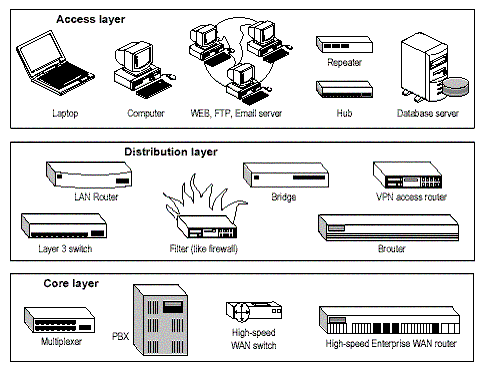
When you implement these layers, each layer might comprise more than two devices or a single device might function across multiple layers.The benefits of the Cisco hierarchical model include:
High reliability: Multiple data paths ensure high network fault tolerance; if one path experiences a problem, then the device can quickly discover a new route.
Core layer: This layer is considered the backbone of the network and includes the high-end switches and high-speed cables such as fiber cables. This layer of the network does not route traffic at the LAN. In addition, no packet manipulation is done by devices in this layer. Rather, this layer is concerned with speed and ensures reliable delivery of packets.
Distribution layer: This layer includes LAN-based routers and layer 3 switches. This layer ensures that packets are properly routed between subnets and VLANs in your enterprise. This layer is also called the Workgroup layer.
Access layer: This layer includes hubs and switches. This layer is also called the desktop layer because it focuses on connecting client nodes, such as workstations to the network. This layer ensures that packets are delivered to end user computers.
Figure INT.2.1 displays the three layers of the Cisco hierarchical model.
When you implement these layers, each layer might comprise more than two devices or a single device might function across multiple layers.The benefits of the Cisco hierarchical model include:
- High Performance: You can design high performance networks, where only certain layers are susceptible to congestion.
- Efficient management & troubleshooting: Allows you to efficiently organize network management and isolate causes of network trouble.
- Policy creation: You can easily create policies and specify filters and rules.
- Scalability: You can grow the network easily by dividing your network into functional areas.
- Behavior prediction: When planning or managing a network, the model allows you determine what will happen to the network when new stresses are placed on it.
Core Layer
The core layer is responsible for fast and reliable transportation of data across a network. The core layer is often known as the backbone or foundation network because all other layers rely upon it. Its purpose is to reduce the latency time in the delivery of packets. The factors to be considered while designing devices to be used in the core layer are:- High data transfer rate: Speed is important at the core layer. One way that core networks enable high data transfer rates is through load sharing, where traffic can travel through multiple network connection
- Low latency period: The core layer typically uses high-speed low latency circuits which only forward packets and do not enforcing policy.
- High reliability: Multiple data paths ensure high network fault tolerance; if one path experiences a problem, then the device can quickly discover a new route.
At the core layer, efficiency is the key term. Fewer and faster systems create a more efficient backbone. There are various equipments available for the core layer. Examples of core layer Cisco equipment include:Distribution LayerThe distribution layer is responsible for routing. It also provides policy-based network connectivity, including:
show ip route summary You can practice viewing routing information using a free CCNA exam router simulator available from SemSim.com. You can also determine how routers update each other’s routing tables by choosing specific routing protocols. Examples of Cisco-specific distribution layer equipment include 2600,4000, 4500 series routers Access LayerThe access layer contains devices that allow workgroups and users to use the services provided by the distribution and core layers. In the access layer, you have the ability to expand or contract collision domains using a repeater, hub, or standard switch. In regards to the access layer, a switch is not a high-powered device, such as those found at the core layer. |
RIP Routing Fundamentals
| RIP stands for Routing Information Protocol. RIP is a dynamic, distance vector routing protocol and was developed for smaller IP based networks. As mentioned earlier, RIP calculates the best route based on hop count. There are currently two versions of RIP protocol.
|
1. Hop Count Limit: Destination that is more than 15 hops away is considered unreachable by RIPv1.
2. Classful Routing Only: RIP is a classful routing protocol. RIPv1 doesn't support classless routing. RIP v1 advertises all networks it knows as classful networks, so it is not possible to subnet a network using RIP v1.
3. Metric limitation: The best route in RIP is determined by counting the number of hops required to reach the destination. A lower hop count route is always preferred over a higher hop count route. One disadvantage of using hop count as metric is that if there is a route with one additional hop, but with significantly higher bandwidth, the route with smaller bandwidth is taken. This is illustrated in the figure below:
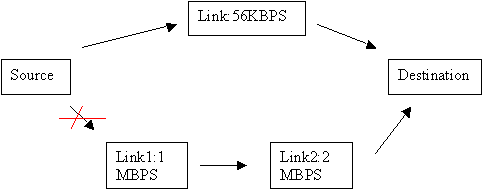
The RIP routed packets take the path through 56KBPS link since the destination can be reached in one hop. Though, the alternative provides a minimum bandwidth of 1MBPS (though using two links of 1MBPS, and 2MBPS each), it represents 2 hops and not preferred by the RIP protocol.
Features of RIP v2:
RIP v2 is a revised version of its predecessor RIP v1. The following are the important feature enhancements provided in RIPv2:1. RIPv2 packets carry the subnet mask in each route entry, making RIPv2 a classless routing protocol. It provides support for variable-length subnet masking (VLSM) and classless addressing (CIDR).
2. Next Hop Specification: In RIPv2, each RIP entry includes a space where an explicit IP address can be entered as the next hop router for datagrams intended for the network in that entry.
For example, this field can be used when the most efficient route to a network is through a router that is not running RIP. Since, that a router will not exchange RIP messages, explicit Next Hop field allows the router to be selected as the next hop router.
3. Authentication: RIPv1 does not support authentication. This loophole may be used maliciously by hackers, that may resulting in delivering the data packets to a fictitious destination as determined by the hacker. RIPv2 provides a basic authentication scheme, so that a router can accept RIP messages from a neighboring router only after ascertaining its authenticity.
4. Route Tag: Each RIPv2 entry includes a Route Tag field, where additional information about a route can be stored. It provides a method for distinguishing between internal routes (learned by RIP) and external routes (learned from other protocols).
Limitations of RIP v2:
One of the biggest limitations of RIPv1 still remains with RIPv2. It is hop count limitation, and metric. The hop count of 16 still remains as unreachable, and the metric still remains hop count. A smaller hop count limits the network diameter, that is the number of routers that can participate in the RIP network.Example Question:
While the packet travels from source to destination through an Internetwork, which of the following statements are true? (Choose 2 best answers).
A. The source and destination hardware (interface) addresses change
B. The source and destination hardware (interface) addresses remain constant.
C. The source and destination IP addresses change
D. The source and destination IP addresses remain constant.
Ans. A, D
Explanation: While a packet travels through an Internetwork, it usually involves multiple hops. It is important to know that the logical address (IP address) of the source (that created the packet) and destination (final intended destination) remain constant, whereas the hardware (interface) addresses change with each hop.
Tuesday, October 5, 2010
Routing Fundamentals
| When IP packets travel over the Internet, routing information is exchanged between the devices that control the flow of information over the Internet. These devices are known as routers, and they use the IP address as the basis for controlling the traffic. These devices need to talk the same language to function properly, though they belong to different administrative domains. For example, one router may be in Newyork(US), and the receiving router may be in London (UK). It is necessary that a routing protocol is followed for smooth flow of traffic. Given below are the widely used routing protocols for routing Internet traffic: |
- RIP v1
- RIP v2
- OSPF
- IGRP
- EIGRP
- BGP
One often get confused between a routing protocol and a routed protocol. A routing protocol such as RIP is used to route information packets over the Internet, where as a routed protocol such as IP (or IPX) is the payload (contains data) that get routed from source to the destination.
Routing protocols are primarily distinguished into three types:
- Distance Vector Protocols
- Link State Protocols
- Hybrid Protocols
The table below provides the routing protocol used with different routed protocols:
| Routing Protocol | Routed Protocol |
| RIP, OSPF,IS-IS, BGP,EIGRP | IP |
| RIP, NLSP, EIGRP | IPX |
| RTMP, EIGRP | AppleTalk |
Routing Metric: This is a fundamental measure that routing protocols use for determining appropriate route to deliver packets. Each routing protocol uses its own measure of metric, and a sample of routing metrics used by different routing protocols is given below:
| Routing Protocol | Metric |
| RIPv2 | Hop count |
| EIGRP | Bandwidth, Delay, Load, Reliability, and MTU |
| OSPF | Cost (Higher bandwidth indicates lower cost) |
| IS-IS | Cost |
The RIP routed packets take the path through 56KBPS link since the destination can be reached in one hop. Though, the alternative provides a minimum bandwidth of 1MBPS (though using two links of 1MBPS, and 2MBPS each), it represents 2 hops and not preferred by the RIP protocol.
Link State vs. Distance Vector
Distance Vector routing protocols usually send their entire routing table to their nearest neighbors at regular intervals. A router that receives several such routing tables filter the routes and arrive at its own and retransmits it to its neighbouring routers. There will some period of time where different routers hold non-optimized routes initially. After some time, known as convergence time, a final routing table is arrived at by all the routers. A faster convergence time results in a stable network.RIP, as mentioned earlier uses hop count as the metric for computing a route to a given destination. Other Distance Vector routing protocols, such as IGRP, improve on this by using hop count, bandwidth, current load, cost, and reliability to determine the best path.
Link State routing protocols usually send only the routing changes to every other router within their area. Unlike Distance Vector, routers using Link State routing protocols maintain a picture of the entire network. A router can use this network wide information to determine the best route for traffic.
Example Question:
What is true about IP routing?
A. The frame changes at each hop
B. The source IP address changes at each hop
C. The destination IP address changes at each hop
D. The hardware interface addresses remain constant
Correct answer: A
Explanation:
IP Packets are transported from source network to the destination network by what is known as routing. Hop-by-hop routing model is used by the Internet for delivery of packets. At each hop, the destination IP address is examined, the best next hop is determined by the routing protocol (such as RIP, OSPF or BGP) and the packet is forwarded by one more hop through this route. The same process takes place at the next hop. During this process, the logical addresses remain same. In an IP network, the logical addresses are IP addresses. The hardware interface addresses, such as MAC address change with each hop.
Monday, October 4, 2010
Subnet masking -II
| What we discussed in the previous section is Classful subnet masking. A Subnetmask normally contains the host portion of the bits also. This is called Classless Inter Domain Routing (CIDR). This will enable more networks for a given class of network address. For example, allowing 3 host bits towards subnet portion in our previous IP address, will allow us to offer 2X2X2 or 8 additional subnetworks. Traditionally, all zeros, and all ones subnets are not used, and hence we are left with 6 subnets. |
255.255.255.224: 1111 1111.1111 1111.1111 1111.1110 0000 Class C subnet mask with 3 additional bits of host portion used for Subnetting.
Broadcast address: 1100 0000.1011 1101.1101 0010.0101 1111 :192.189.210.95
The above is the broadcast address for a given subnet (192.189.210.078). Under Classful routing, the broadcast address would have been 192.189.210.255.
Note that by using Subnetting, we are able to increase the number of networks available within a given IP address. On the otherhand, we will be loosing the number of hosts available within a subnet to 24 or 16 hosts per subnet. Again, all zeros, and all ones host addresses are traditionally reserved for other purposes.
CIDR (Classless InterDomain Routing) notation: Subnet mask is also represented as below:
192.189.210.078/27, where 27 is the number of bits in the network portion of the IP address.
Why use CIDR?
Normally, ISPs allocate the IP addresses for individuals or Corporates. The reason being that it is almost impossible to allocate a classful IP address to every individual or a corporate. Using CIDR, the biggest ISPs are given large pool of IP address space. The ISP's customers such as individual or Corporates are then allocated networks from the big ISP's pool. This kind of arrangement will enable efficient management and utilization of the Internet.
Classful addresses can easily be written in CIDR notation
Class A = A.B.C.D/8, Class B = A.B.C.D/16, and Class C = A.B.C.D/24
Where A,B,C,D are dotted decimal octets.
Example Question:
You have an IP of 156.233.42.56 with a subnet mask of 7 bits. How many hosts and subnets are possible?
A. 126 hosts and 510 subnetsCorrect answer: C
B. 128 subnets and 512 hosts
C. 510 hosts and 126 subnets
D. 512 subnets and 128 hosts
Explanation:
Class B network has the form N.N.H.H, the default subnet mask is 16 bits long.
There is additional 7 bits to the default subnet mask. The total number of bits in subnet are 16+7 = 23.
This leaves us with 32-23 =9 bits for assigning to hosts.
7 bits of subnet mask corresponds to (2^7-2)=128-2 = 126 subnets.
9 bits belonging to host addresses correspond to (2^9-2)=512-2 = 510 hosts.
Sunday, March 29, 2009
CCNA Exploration 1 - FINAL Exam Answers Version 4.0
1. Refer to the exhibit. Host B attempts to establish a TCP/IP session with host C. During this attempt, a frame was captured at the FastEthernet interface fa0/1 of the San Francisco router. The packet inside the captured frame has the source IP address 10.10.1.2, and the destination IP address is 10.31.1.20. What is the destination MAC address of the frame at the time of capture?
• 0060.7320.D632
• 0060.7320.D631
• 0040.8517.44C3
• 0009.B2E4.EE03
• 0010.C2B4.3421
2. What are three characteristics of CSMA/CD? (Choose three.)
• It monitors the media for presence of a data signal.
• After detecting a collision, hosts can resume transmission after a random timer has expired.
• A jam signal is used to ensure that all hosts are aware that a collision has occurred.
• Devices can be configured with a higher transmission priority.
• Data is transmitted only when the data signal is present.
• It uses a token system to avoid collisions.
3. Refer to the exhibit. The PC, the routing table of which is displayed, is configured correctly. To which network device or interface does the IP address 192.168.1.254 belong?
• PC
• switch
• router interface fa0/0
• router interface fa0/1
4. Refer to the exhibit. Host A wants to access the Internet. Which combination of a Layer 2 address and a Layer 3 address will enable this access from host A?
• Destination MAC: 0030.8596.DE83 Default gateway: 209.165.202.130
• Destination MAC: 0030.8596.DE82 Default gateway: 172.16.9.2
• Destination MAC: 0030.8517.44C4 Default gateway: 172.16.1.1
• Destination MAC: 0030.8517.44C4 Default gateway: 209.165.202.130
5. Refer to the exhibit. Communication between hosts X and Y is restricted to the local network. What is the reason for this?
• The gateway addresses are broadcast addresses.
• Host Y is assigned a multicast address.
• Host X and host Y belong to different networks.
• Host X is assigned a network address.
6. What is the result of using the clock rate 56000 command at the serial interface of the router?
• The interface is configured as a DCE device.
• The interface timers are cleared.
• The FastEthernet interface is made to emulate a serial interface by assigning it a timing signal.
• The IP address for the serial interface is configured.
7. Which three addresses belong to the category of public IP addresses? (Choose three.)
• 127.0.0.1
• 196.1.105.6
• 132.11.9.99
• 10.0.0.1
• 172.16.9.10
• 46.1.1.97
• 192.168.1.191
• 192.168.1.101
• 192.168.1.1
• 192.168.1.254
50. Which three statements are true about network layer addressing? (Choose three.)
• It uniquely identifies each host.
• It assists in forwarding packets across internetworks.
• It uses a logical 32-bit IPv4 address.
• It is not a configurable address.
• It is a physical address.
• It identifies the host from the first part of the address.
• 0060.7320.D632
• 0060.7320.D631
• 0040.8517.44C3
• 0009.B2E4.EE03
• 0010.C2B4.3421
2. What are three characteristics of CSMA/CD? (Choose three.)
• It monitors the media for presence of a data signal.
• After detecting a collision, hosts can resume transmission after a random timer has expired.
• A jam signal is used to ensure that all hosts are aware that a collision has occurred.
• Devices can be configured with a higher transmission priority.
• Data is transmitted only when the data signal is present.
• It uses a token system to avoid collisions.
3. Refer to the exhibit. The PC, the routing table of which is displayed, is configured correctly. To which network device or interface does the IP address 192.168.1.254 belong?
• PC
• switch
• router interface fa0/0
• router interface fa0/1
4. Refer to the exhibit. Host A wants to access the Internet. Which combination of a Layer 2 address and a Layer 3 address will enable this access from host A?
• Destination MAC: 0030.8596.DE83 Default gateway: 209.165.202.130
• Destination MAC: 0030.8596.DE82 Default gateway: 172.16.9.2
• Destination MAC: 0030.8517.44C4 Default gateway: 172.16.1.1
• Destination MAC: 0030.8517.44C4 Default gateway: 209.165.202.130
5. Refer to the exhibit. Communication between hosts X and Y is restricted to the local network. What is the reason for this?
• The gateway addresses are broadcast addresses.
• Host Y is assigned a multicast address.
• Host X and host Y belong to different networks.
• Host X is assigned a network address.
6. What is the result of using the clock rate 56000 command at the serial interface of the router?
• The interface is configured as a DCE device.
• The interface timers are cleared.
• The FastEthernet interface is made to emulate a serial interface by assigning it a timing signal.
• The IP address for the serial interface is configured.
7. Which three addresses belong to the category of public IP addresses? (Choose three.)
• 127.0.0.1
• 196.1.105.6
• 132.11.9.99
• 10.0.0.1
• 172.16.9.10
• 46.1.1.97
8. Which three statements are true about transport layer protocols? (Choose three.)
• TCP and UDP manage communication between multiple applications.
• TCP retransmits the packets for which the acknowledgment is not received.
• TCP acknowledges received data.
• UDP exchanges frames between the nodes of the network.
• TCP has no mechanism to acknowledge transmission errors.
• UDP uses windowing and sequencing to provide reliable transfer of data.
9. Refer to the exhibit. Which logical topology describes the exhibited network?
• star
• ring
• point-to-point
• multi-access
• TCP and UDP manage communication between multiple applications.
• TCP retransmits the packets for which the acknowledgment is not received.
• TCP acknowledges received data.
• UDP exchanges frames between the nodes of the network.
• TCP has no mechanism to acknowledge transmission errors.
• UDP uses windowing and sequencing to provide reliable transfer of data.
9. Refer to the exhibit. Which logical topology describes the exhibited network?
• star
• ring
• point-to-point
• multi-access
10. Which statement is true about the running configuration file in a Cisco IOS device?
• It affects the operation of the device immediately when modified.
• It is stored in NVRAM.
• It should be deleted using the erase running-config command.
• It is automatically saved when the router reboots.
11. Refer to the exhibit. Host C is able to ping 127.0.0.1 successfully, but is unable to communicate with hosts A and B in the organization. What is the likely cause of the problem?
• Hosts A and B are not on the same subnet as host C.
• The IP addresses on the router serial interfaces are wrong.
• The subnet mask on host C is improperly configured.
• The FastEthernet interface fa0/0 of router 1 is wrongly configured.
12. A host is transmitting a video over the network. How does the transport layer allow this host to use multiple applications to transmit other data at the same time as the video transmission?
• It uses error control mechanisms.
• It uses a connectionless protocol only for multiple simultaneous transmissions.
• It uses multiple Layer 2 source addresses.
• It uses multiple port numbers.
13. Refer to the exhibit. PC1 is unable to access PC2. To troubleshoot this problem, the technician needs to confirm that the next hop interface is operational. Which default gateway address should the technician ping from PC1 to confirm this?
• 10.0.0.254
• 192.168.0.249
• 192.168.0.250
• 10.0.1.254
• It affects the operation of the device immediately when modified.
• It is stored in NVRAM.
• It should be deleted using the erase running-config command.
• It is automatically saved when the router reboots.
11. Refer to the exhibit. Host C is able to ping 127.0.0.1 successfully, but is unable to communicate with hosts A and B in the organization. What is the likely cause of the problem?
• Hosts A and B are not on the same subnet as host C.
• The IP addresses on the router serial interfaces are wrong.
• The subnet mask on host C is improperly configured.
• The FastEthernet interface fa0/0 of router 1 is wrongly configured.
12. A host is transmitting a video over the network. How does the transport layer allow this host to use multiple applications to transmit other data at the same time as the video transmission?
• It uses error control mechanisms.
• It uses a connectionless protocol only for multiple simultaneous transmissions.
• It uses multiple Layer 2 source addresses.
• It uses multiple port numbers.
13. Refer to the exhibit. PC1 is unable to access PC2. To troubleshoot this problem, the technician needs to confirm that the next hop interface is operational. Which default gateway address should the technician ping from PC1 to confirm this?
• 10.0.0.254
• 192.168.0.249
• 192.168.0.250
• 10.0.1.254
14. Refer to the exhibit. Cable 1 and Cable 2 are wired for specific physical layer requirements. Which three segments use Cable 2? (Choose three.)
• Segment 1
• Segment 2
• Segment 3
• Segment 4
• Segment 5
• Segment 6
15. Refer to the exhibit. Which two facts can be determined about the topology? (Choose two.)
• Three networks are needed.
• Two logical address ranges are required.
• A single broadcast domain is present.
• Three collision domains are present.
• Four networks are needed.
16. Refer to the exhibit. Which three statements are true about the IP configuration that is displayed? (Choose three.)
• The assigned address is a private address.
• The PC cannot communicate with the DNS server.
• The network can have 126 hosts.
• The prefix of the computer address is /26.
• The IP address is routable on the Internet.
• The IP address is a multicast address. 17. Which password restricts Telnet access to the router?
• enable
• enable secret
• console
• VTY
18. Refer to the exhibit. To create the initial configuration, a network technician connected host A to the router using the connection that is shown. Which statement is true about this connection?
• It terminates at the Ethernet port of the router.
• It provides out-of-band console access.
• It terminates at the serial interface of the router.
• It requires a Telnet client on host A to access the router. 19. Which device should be used for routing a packet to a remote network?
• access switch
• DHCP server
• hub
• router
• Segment 1
• Segment 2
• Segment 3
• Segment 4
• Segment 5
• Segment 6
15. Refer to the exhibit. Which two facts can be determined about the topology? (Choose two.)
• Three networks are needed.
• Two logical address ranges are required.
• A single broadcast domain is present.
• Three collision domains are present.
• Four networks are needed.
16. Refer to the exhibit. Which three statements are true about the IP configuration that is displayed? (Choose three.)
• The assigned address is a private address.
• The PC cannot communicate with the DNS server.
• The network can have 126 hosts.
• The prefix of the computer address is /26.
• The IP address is routable on the Internet.
• The IP address is a multicast address. 17. Which password restricts Telnet access to the router?
• enable
• enable secret
• console
• VTY
18. Refer to the exhibit. To create the initial configuration, a network technician connected host A to the router using the connection that is shown. Which statement is true about this connection?
• It terminates at the Ethernet port of the router.
• It provides out-of-band console access.
• It terminates at the serial interface of the router.
• It requires a Telnet client on host A to access the router. 19. Which device should be used for routing a packet to a remote network?
• access switch
• DHCP server
• hub
• router
20. Refer to the exhibit. The serial interface of the router was configured with the use of the commands that are shown. The router cannot ping the router that is directly connected to interface serial 0/0/0. What should the network technician do to solve this problem?
• Configure the description at interface serial 0/0/0.
• Configure an IP address on interface serial 0/0/0.
• Remove the no shutdown command at interface serial 0/0/0
• Reboot the router.
21. Refer to the exhibit. In a network, host A is sending data segments to host B. The flow control of the segments that are being exchanged is displayed. Which two statements are true about this communication? (Choose two.)
• The initial window size is determined via the two-way handshake.
• The window size for the TCP session that is represented is initially set to 3000 bytes.
• Acknowledgment number 3001 indicates that host A will send the next segment with sequence number 3001.
• Host B expects that the next received segment number will be 3000.
• No more acknowledgments will be exchanged.
• Configure the description at interface serial 0/0/0.
• Configure an IP address on interface serial 0/0/0.
• Remove the no shutdown command at interface serial 0/0/0
• Reboot the router.
21. Refer to the exhibit. In a network, host A is sending data segments to host B. The flow control of the segments that are being exchanged is displayed. Which two statements are true about this communication? (Choose two.)
• The initial window size is determined via the two-way handshake.
• The window size for the TCP session that is represented is initially set to 3000 bytes.
• Acknowledgment number 3001 indicates that host A will send the next segment with sequence number 3001.
• Host B expects that the next received segment number will be 3000.
• No more acknowledgments will be exchanged.
22. Refer to the exhibit. The network administrator wants to remotely access the CLI of the router from PC1 using modem 1. Which port of the router should be connected to modem 2 to enable this access?
• console
• Ethernet
• auxiliary
• serial 23. Which OSI layer uses a connection-oriented protocol to ensure reliable delivery of data?
• application layer
• presentation layer
• session layer
• transport layer 24. What are two functions of the data link layer? (Choose two.)
• It segments and reorders the data.
• It exchanges data between programs that are running on the source and destination hosts.
• It controls how data is placed onto the media.
• It generates signals to represent the bits in each frame.
• It encapsulates each packet with a header and a trailer to transfer it across the local media. 25. Refer to the exhibit. Which list refers only to end devices?
• D,E,F,G
• A,H,B,C
• A,D,E,F
• A,D,E,G
26. Refer to the exhibit. The diagram represents the process of sending e-mail between clients. Which list correctly identifies the component or protocol used at each numbered stage of the diagram?
• 1.MUA 2.MDA 3.MTA 4.SMTP 5.MTA 6.POP 7.MDA 8.MUA
• 1.MUA 2.POP 3.MDA 4.SMTP 5.MTA 6.MDA 7.SMTP 8.MUA
• 1.MUA 2.POP 3.SMTP 4.MDA 5.MTA 6.SMTP 7.POP 8.MUA
• 1.MUA 2.SMTP 3.MTA 4.SMTP 5.MTA 6.MDA 7.POP 8.MUA
27. Refer to the exhibit. Host B was powered off. What change will occur in the MAC table of the switch?
The table will remain unaffected.
• The switch will remove the MAC address at Fa0/19 immediately.
• The switch will retain the MAC address until host B is powered on again.
• The switch will rebuild the MAC table by assigning the FFFF.FFFF.FFFF address to port Fa0/19.
28. Refer to the exhibit. A technician has connected the PC to the switch using a Category 6 UTP cable. Which two statements are true about this connection? (Choose two.)
• The cable that is used is an Ethernet crossover cable.
• The transmit pin of the cable is terminated to the receive pin.
• The maximum distance between the switch and the PC can be 100 m.
• The maximum supported bandwidth is 1000 Mb/s.
• The Category 6 cable simulates a point-to-point WAN link and is unusable for this type of connection.
29. Refer to the exhibit. A host is using NAT to connect to the Internet. Which three IP addresses enable this connection? (Choose three.)
• 10.1.1.63
• 10.1.1.37
• 10.1.1.39
• 10.1.1.32
• 10.1.1.60
• 10.1.1.2 30. Refer to the exhibit. A PC is communicating with another PC on a remote network. The two networks are connected by three routers. Which action will help to identify the path between the hosts?
• Use the ipconfig command at the host.
• Use the ipconfig/all command at the destination.
• Use the tracert command at the host.
• Use the ping command at the destination.
31. An organization wants to create a subnet of the IP network 172.16.0.0. This subnet will accommodate 1000 hosts. Which subnet mask should be assigned to this network?
• 255.255.0.0
• 255.255.248.0
• 255.255.252.0
• 255.255.254.0
• 255.255.255.0
• 255.255.255.128
32. Refer to the exhibit. A host is connected to hub 1. Which combination of IP address, subnet mask, and default gateway can allow this host to function in the network?
• IP address: 172.16.31.36 Subnet mask: 255.255.255.240 Default gateway: 172.16.31.35
• IP address: 172.16.31.63 Subnet mask: 255.255.255.224 Default gateway: 172.16.31.35
IP address: 172.16.31.29 Subnet mask: 255.255.255.248 Default gateway: 172.16.31.35
• IP address: 172.16.31.32 Subnet mask: 255.255.255.224 Default gateway: 172.16.31.35
• IP address: 172.16.31.29 Subnet mask: 255.255.255.240 Default gateway: 172.16.30.1
• IP address: 172.16.31.37 Subnet mask: 255.255.255.224 Default gateway: 172.16.31.35
33. Refer to the exhibit. A technician uses the nslookup command on the PC and views the output that is displayed in the exhibit. What is the IP address of the primary domain name server configured at the host? (Choose two.)
• 192.168.1.99
• 192.168.2.100
• 10.10.10.32
• 192.168.1.5
• the IP address of the website resolver1.xyz.local
34. Which OSI layer offers ordered data reconstruction services?
• application layer
• network layer
• presentation layer
• session layer
• transport layer
• console
• Ethernet
• auxiliary
• serial 23. Which OSI layer uses a connection-oriented protocol to ensure reliable delivery of data?
• application layer
• presentation layer
• session layer
• transport layer 24. What are two functions of the data link layer? (Choose two.)
• It segments and reorders the data.
• It exchanges data between programs that are running on the source and destination hosts.
• It controls how data is placed onto the media.
• It generates signals to represent the bits in each frame.
• It encapsulates each packet with a header and a trailer to transfer it across the local media. 25. Refer to the exhibit. Which list refers only to end devices?
• D,E,F,G
• A,H,B,C
• A,D,E,F
• A,D,E,G
26. Refer to the exhibit. The diagram represents the process of sending e-mail between clients. Which list correctly identifies the component or protocol used at each numbered stage of the diagram?
• 1.MUA 2.MDA 3.MTA 4.SMTP 5.MTA 6.POP 7.MDA 8.MUA
• 1.MUA 2.POP 3.MDA 4.SMTP 5.MTA 6.MDA 7.SMTP 8.MUA
• 1.MUA 2.POP 3.SMTP 4.MDA 5.MTA 6.SMTP 7.POP 8.MUA
• 1.MUA 2.SMTP 3.MTA 4.SMTP 5.MTA 6.MDA 7.POP 8.MUA
27. Refer to the exhibit. Host B was powered off. What change will occur in the MAC table of the switch?
The table will remain unaffected.
• The switch will remove the MAC address at Fa0/19 immediately.
• The switch will retain the MAC address until host B is powered on again.
• The switch will rebuild the MAC table by assigning the FFFF.FFFF.FFFF address to port Fa0/19.
28. Refer to the exhibit. A technician has connected the PC to the switch using a Category 6 UTP cable. Which two statements are true about this connection? (Choose two.)
• The cable that is used is an Ethernet crossover cable.
• The transmit pin of the cable is terminated to the receive pin.
• The maximum distance between the switch and the PC can be 100 m.
• The maximum supported bandwidth is 1000 Mb/s.
• The Category 6 cable simulates a point-to-point WAN link and is unusable for this type of connection.
29. Refer to the exhibit. A host is using NAT to connect to the Internet. Which three IP addresses enable this connection? (Choose three.)
• 10.1.1.63
• 10.1.1.37
• 10.1.1.39
• 10.1.1.32
• 10.1.1.60
• 10.1.1.2 30. Refer to the exhibit. A PC is communicating with another PC on a remote network. The two networks are connected by three routers. Which action will help to identify the path between the hosts?
• Use the ipconfig command at the host.
• Use the ipconfig/all command at the destination.
• Use the tracert command at the host.
• Use the ping command at the destination.
31. An organization wants to create a subnet of the IP network 172.16.0.0. This subnet will accommodate 1000 hosts. Which subnet mask should be assigned to this network?
• 255.255.0.0
• 255.255.248.0
• 255.255.252.0
• 255.255.254.0
• 255.255.255.0
• 255.255.255.128
32. Refer to the exhibit. A host is connected to hub 1. Which combination of IP address, subnet mask, and default gateway can allow this host to function in the network?
• IP address: 172.16.31.36 Subnet mask: 255.255.255.240 Default gateway: 172.16.31.35
• IP address: 172.16.31.63 Subnet mask: 255.255.255.224 Default gateway: 172.16.31.35
IP address: 172.16.31.29 Subnet mask: 255.255.255.248 Default gateway: 172.16.31.35
• IP address: 172.16.31.32 Subnet mask: 255.255.255.224 Default gateway: 172.16.31.35
• IP address: 172.16.31.29 Subnet mask: 255.255.255.240 Default gateway: 172.16.30.1
• IP address: 172.16.31.37 Subnet mask: 255.255.255.224 Default gateway: 172.16.31.35
33. Refer to the exhibit. A technician uses the nslookup command on the PC and views the output that is displayed in the exhibit. What is the IP address of the primary domain name server configured at the host? (Choose two.)
• 192.168.1.99
• 192.168.2.100
• 10.10.10.32
• 192.168.1.5
• the IP address of the website resolver1.xyz.local
34. Which OSI layer offers ordered data reconstruction services?
• application layer
• network layer
• presentation layer
• session layer
• transport layer
35. Refer to the exhibit. All devices in the network use default configurations. How many logical address ranges are required in this topology?
• 2
• 3
• 4
• 5
• 6
36. The network administrator wants to install a private application on a server. Which range of port numbers is normally assigned to this application to make it accessible by clients?
• 0 to 255
• 49152 to 65535
• 1024 to 49151
• 0 to 1023
37. Because of a security violation, the router password must be changed. What information can be learned from these configuration entries? (Choose two.)
• 2
• 3
• 4
• 5
• 6
36. The network administrator wants to install a private application on a server. Which range of port numbers is normally assigned to this application to make it accessible by clients?
• 0 to 255
• 49152 to 65535
• 1024 to 49151
• 0 to 1023
37. Because of a security violation, the router password must be changed. What information can be learned from these configuration entries? (Choose two.)
• Router(config)# line vty 0 4
Router(config-line)# password arj15
Router(config-line)# login
• This configuration allows users to connect by using a modem.
• Users must specify which line, 0 or 4, they wish to connect to when making a connection.
• This configuration allows users to connect to the router via the use of the telnet command.
• This configuration allows five users to make simultaneous connections to this router.
• The configured password is automatically encrypted on the router.
38. Refer to the exhibit. Each media link is labeled. What type of cable should be used to connect the different devices?
• Connection 1 - rollover cable Connection 2 - straight-through cable Connection 3 - crossover cable
• Connection 1 - straight-through cable Connection 2 - crossover cable Connection 3 - rollover cable
• Connection 1 - crossover cable Connection 2 - rollover cable Connection 3 - straight-through cable
• Connection 1 - crossover cable Connection 2 - straight-through cable Connection 3 - rollover cable
• Connection 1 - straight-through cable Connection 2 - straight-through cable Connection 3 - straight-through cable
39. Which two types of media are useful for connecting two devices separated by a distance of 500 meters? (Choose two.)
• 10 BASE-T
• 1000 BASE-TX
• 10 BASE-2
• 1000 BASE LX
• 1000 BASE-SX 40. Which information is used by the router to determine the path between the source and destination hosts?
• the host portion of the IP address
• the network portion of the IP address
• host default gateway address
• the MAC address
41. Refer to the exhibit. What two facts can be determined from the session information that is displayed? (Choose two.)
• This exchange is part of the three-way handshake.
• The destination port indicates that a Telnet session has been initiated.
• The source port does not support communication with the destination port that is listed.
• The destination port indicates that an SMTP session has been initiated.
• The protocol is a connection-oriented protocol.
42. Refer to the exhibit. Host A is accessing multiple servers. Which combination of port number and address will uniquely identify a particular process running on a specific server?
• MAC address of the server and port number of the service
• IP address of the host and port number of the service
• MAC address of the host and port number of the service
• IP address of the server and port number of the service
43. A network technician wants to configure an IP address on a router interface by using the ip address 192.168.1.0 255.255.255.0 command. Which prompt should the technician see when entering this command?
• Router>
• Router(config-if)#
• Router#
• Router(config)# 44. Refer to the exhibit. Host X is unable to communicate with host Y. Which command can be run at host X to determine which intermediary device is responsible for this failure?
• telnet 192.168.1.1
• ping 192.168.1.1
• ftp 192.168.1.1
• tracert 192.168.1.1
• This configuration allows users to connect by using a modem.
• Users must specify which line, 0 or 4, they wish to connect to when making a connection.
• This configuration allows users to connect to the router via the use of the telnet command.
• This configuration allows five users to make simultaneous connections to this router.
• The configured password is automatically encrypted on the router.
38. Refer to the exhibit. Each media link is labeled. What type of cable should be used to connect the different devices?
• Connection 1 - rollover cable Connection 2 - straight-through cable Connection 3 - crossover cable
• Connection 1 - straight-through cable Connection 2 - crossover cable Connection 3 - rollover cable
• Connection 1 - crossover cable Connection 2 - rollover cable Connection 3 - straight-through cable
• Connection 1 - crossover cable Connection 2 - straight-through cable Connection 3 - rollover cable
• Connection 1 - straight-through cable Connection 2 - straight-through cable Connection 3 - straight-through cable
39. Which two types of media are useful for connecting two devices separated by a distance of 500 meters? (Choose two.)
• 10 BASE-T
• 1000 BASE-TX
• 10 BASE-2
• 1000 BASE LX
• 1000 BASE-SX 40. Which information is used by the router to determine the path between the source and destination hosts?
• the host portion of the IP address
• the network portion of the IP address
• host default gateway address
• the MAC address
41. Refer to the exhibit. What two facts can be determined from the session information that is displayed? (Choose two.)
• This exchange is part of the three-way handshake.
• The destination port indicates that a Telnet session has been initiated.
• The source port does not support communication with the destination port that is listed.
• The destination port indicates that an SMTP session has been initiated.
• The protocol is a connection-oriented protocol.
42. Refer to the exhibit. Host A is accessing multiple servers. Which combination of port number and address will uniquely identify a particular process running on a specific server?
• MAC address of the server and port number of the service
• IP address of the host and port number of the service
• MAC address of the host and port number of the service
• IP address of the server and port number of the service
43. A network technician wants to configure an IP address on a router interface by using the ip address 192.168.1.0 255.255.255.0 command. Which prompt should the technician see when entering this command?
• Router>
• Router(config-if)#
• Router#
• Router(config)# 44. Refer to the exhibit. Host X is unable to communicate with host Y. Which command can be run at host X to determine which intermediary device is responsible for this failure?
• telnet 192.168.1.1
• ping 192.168.1.1
• ftp 192.168.1.1
• tracert 192.168.1.1
45. Refer to the exhibit. In a network, PC1 sends a message to PC2. The frame received at PC2 is shown. What information in this frame determines the correct destination application?
• timing and synchronization bits
• destination and source physical addresses
• destination and source logical network addresses
• destination and source process numbers
46. An organization has been assigned network ID 10.10.128.0 and subnet mask 255.255.224.0. Which IP address range can be used for this organization?
• 10.10.128.0 to 10.10.160.255
• 10.10.128.0 to 10.10.159.255
• 10.10.128.0 to 10.10.192.255
• 10.10.128.0 to 10.10.0.159
• 10.10.128.0 to 10.10.159.0
47. What is the effect of using the Router# copy running-config startup-config command on a router?
• The contents of ROM will change.
• The contents of RAM will change.
• The contents of NVRAM will change.
• The contents of flash will change.
• timing and synchronization bits
• destination and source physical addresses
• destination and source logical network addresses
• destination and source process numbers
46. An organization has been assigned network ID 10.10.128.0 and subnet mask 255.255.224.0. Which IP address range can be used for this organization?
• 10.10.128.0 to 10.10.160.255
• 10.10.128.0 to 10.10.159.255
• 10.10.128.0 to 10.10.192.255
• 10.10.128.0 to 10.10.0.159
• 10.10.128.0 to 10.10.159.0
47. What is the effect of using the Router# copy running-config startup-config command on a router?
• The contents of ROM will change.
• The contents of RAM will change.
• The contents of NVRAM will change.
• The contents of flash will change.
48. Which three IPv4 addresses represent valid host addresses for a subnet? (Choose three.)
• 10.1.12.79/28
• 10.1.12.113/28
• 10.1.12.32/28
• 10.1.11.5/27
• 10.1.11.97/27
• 10.1.11.128/27
49. Refer to the exhibit. The NAT functionality of the router is enabled to provide Internet access to the PC. However, the PC is still unable to access the Internet. Which IP address should be changed to 209.165.201.1 to enable the PC to access the Internet?• 10.1.12.79/28
• 10.1.12.113/28
• 10.1.12.32/28
• 10.1.11.5/27
• 10.1.11.97/27
• 10.1.11.128/27
• 192.168.1.191
• 192.168.1.101
• 192.168.1.1
• 192.168.1.254
50. Which three statements are true about network layer addressing? (Choose three.)
• It uniquely identifies each host.
• It assists in forwarding packets across internetworks.
• It uses a logical 32-bit IPv4 address.
• It is not a configurable address.
• It is a physical address.
• It identifies the host from the first part of the address.
Subscribe to:
Posts (Atom)