Monday, September 28, 2009
CCNA4: Final Exam
Review Notes, v. 3.1
1.1.1 Private addressing

1.1.2 Major NAT and PAT features
Dynamic NAT is designed to map a private IP address to a public address. Any IP address from a pool of public IP addresses is assigned to a network host. Overloading, or Port Address Translation (PAT), maps multiple private IP addresses to a single public IP address. Multiple addresses can be mapped to a single address because each private address is tracked by a port number.
1.1.3 Configuring NAT and PAT
The access list must permit only those addresses that are to be translated. Remember that there is an implicit “deny all” at the end of each access list.

1.1.4 Configuring DHCP
- Typically, a DHCP server will be configured to assign much more than an IP address. Other IP configuration values such as the default gateway can be set from the DHCP configuration mode. Using the default-router command sets the default gateway.
- A default router must be defined for clients
2.1.1 WAN devices
- For digital lines, a channel service unit (CSU) and a data service unit (DSU) are required. The two are often combined into a single piece of equipment, called the CSU/DSU. The CSU/DSU may also be built into the interface card in the router.
- A modem is needed if the local loop is analog rather than digital.
- A router is commonly considered a DTE device.
2.1.2 WAN Standards
WANs use the OSI reference model, but focus mainly on Layer 1 and Layer 2.
2.2.1 ISDN
- Another common application of ISDN is to provide additional capacity as needed on a leased line connection.
- ISDN is also used as a backup in the case of a failure of the leased line.
I will post chapter 3,4 on wednesday. See you soon. if you like this post, you can bookmarks this site. and get up date.
1.1.1 Private addressing

Dynamic NAT is designed to map a private IP address to a public address. Any IP address from a pool of public IP addresses is assigned to a network host. Overloading, or Port Address Translation (PAT), maps multiple private IP addresses to a single public IP address. Multiple addresses can be mapped to a single address because each private address is tracked by a port number.
1.1.3 Configuring NAT and PAT
The access list must permit only those addresses that are to be translated. Remember that there is an implicit “deny all” at the end of each access list.

- Typically, a DHCP server will be configured to assign much more than an IP address. Other IP configuration values such as the default gateway can be set from the DHCP configuration mode. Using the default-router command sets the default gateway.
- A default router must be defined for clients
2.1.1 WAN devices
- For digital lines, a channel service unit (CSU) and a data service unit (DSU) are required. The two are often combined into a single piece of equipment, called the CSU/DSU. The CSU/DSU may also be built into the interface card in the router.
- A modem is needed if the local loop is analog rather than digital.
- A router is commonly considered a DTE device.
2.1.2 WAN Standards
WANs use the OSI reference model, but focus mainly on Layer 1 and Layer 2.
2.2.1 ISDN
- Another common application of ISDN is to provide additional capacity as needed on a leased line connection.
- ISDN is also used as a backup in the case of a failure of the leased line.
I will post chapter 3,4 on wednesday. See you soon. if you like this post, you can bookmarks this site. and get up date.
Tuesday, September 15, 2009
Packet Tracer 5.1 for Windows with Cisco Official tutorials
Cisco has very recently launched the new version of Packet Tracer 5.1. I have uploaded the software with tutorials for the users who are preparing of Cisco exams or improving their network design concepts
 Enjoy!
Packet Tracer 5.1 Version
CODE
http://rapidshare.com/files/182507939/PacketTracer_5.1_windows_setup___cisco_official_tutorials_by_heightofglory.part1
of2.rar
http://rapidshare.com/files/182486892/PacketTracer_5.1_windows_setup___cisco_official_tutorials_by_heightofglory.part2
of2.rar
Packet Tracer 5 Version
CODE
http://rapidshare.com/files/169210783/Packet_Tracer_5_with_Official_Tutorial_CCNA_v4.0_640-802_by_heightofglory.part1of3.rar
http://rapidshare.com/files/169226160/Packet_Tracer_5_with_Official_Tutorial_CCNA_v4.0_640-802_by_heightofglory.part2of3.rar
http://rapidshare.com/files/169196881/Packet_Tracer_5_with_Official_Tutorial_CCNA_v4.0_640-802_by_heightofglory.part3of3.rar
http://www.mediafire.com/?mimk1gudtyg
http://www.mediafire.com/?yzxyjy2lzqz
Download 25MB (without tutorials)
Download 100MB(with tutorials and labs)
Packet Tracer 5.1 is the latest version of Cisco Networking Academy’s comprehensive networking technology teaching and learning software. Innovative features of Packet Tracer 5.1, including powerful simulation, visualization, authoring, assessment, and collaboration capabilities, will help to solve problems, and learn concepts in an engaging and dynamic social environment.
PT 5.1 supports the following protocols:
HTTP, Telnet, SSH, TFTP, DHCP, and DNS
TCP and UDP; IPv4, IPv6, ICMPv4, and ICMPv6
RIP, EIGRP, multi-area OSPF, static routing, and route redistribution
Ethernet/802.3, 802.11, HDLC, Frame Relay, and PPP
ARP, CDP, STP, RSTP, 802.1q, VTP, DTP, and PAgP
Packet Tracer 5.1 Version
CODE
http://rapidshare.com/files/182507939/PacketTracer_5.1_windows_setup___cisco_official_tutorials_by_heightofglory.part1
of2.rar
http://rapidshare.com/files/182486892/PacketTracer_5.1_windows_setup___cisco_official_tutorials_by_heightofglory.part2
of2.rar
Packet Tracer 5 Version
CODE
http://rapidshare.com/files/169210783/Packet_Tracer_5_with_Official_Tutorial_CCNA_v4.0_640-802_by_heightofglory.part1of3.rar
http://rapidshare.com/files/169226160/Packet_Tracer_5_with_Official_Tutorial_CCNA_v4.0_640-802_by_heightofglory.part2of3.rar
http://rapidshare.com/files/169196881/Packet_Tracer_5_with_Official_Tutorial_CCNA_v4.0_640-802_by_heightofglory.part3of3.rar
http://www.mediafire.com/?mimk1gudtyg
http://www.mediafire.com/?yzxyjy2lzqz
Download 25MB (without tutorials)
Download 100MB(with tutorials and labs)
Packet Tracer 5.1 is the latest version of Cisco Networking Academy’s comprehensive networking technology teaching and learning software. Innovative features of Packet Tracer 5.1, including powerful simulation, visualization, authoring, assessment, and collaboration capabilities, will help to solve problems, and learn concepts in an engaging and dynamic social environment.
Donwload Free Certbible, The Most Realistic Practice Questions and Answers,Help You Pass any Exams
Packet Tracer supplements classroom equipment and provides students complementary learning opportunities that are not physically possible to create in the classroom or lab. Packet Tracer 5.1 offers a unique combination of realistic simulation and visualization experiences.PT 5.1 supports the following protocols:
HTTP, Telnet, SSH, TFTP, DHCP, and DNS
TCP and UDP; IPv4, IPv6, ICMPv4, and ICMPv6
RIP, EIGRP, multi-area OSPF, static routing, and route redistribution
Ethernet/802.3, 802.11, HDLC, Frame Relay, and PPP
ARP, CDP, STP, RSTP, 802.1q, VTP, DTP, and PAgP
Monday, September 14, 2009
CCNA 4 Final
1. A network administrator is asked to design a system to allow simultaneous access to the Internet for 250 users. The ISP for this network can only supply five public IPs. What can be used to accomplish this task?
routable translation
dynamic translation
static translation
• port address translation
2. The LAN attached to the Ethernet interface of the Raleigh router shown in the graphic is addressed with private IP addresses. If one public IP is assigned to the company, which commands could be used in a configuration that allows all devices with private IPs in this network to access the Internet? (Choose two.)
• ip nat inside source list 1 interface serial0 overload
ip nat outside source list 1 interface serial0 overload
ip nat inside serial0
• ip nat inside source list 1 pool Raleigh overload
ip nat inside Raleigh overload
ip inside nat source list 1 interface serial0 Raleigh
3. The command output shown in the graphic was taken from a Cisco 806 broadband router. Which kind of address translation is in effect on this router?
static
dynamic
• overload
private
public
4. Which of the following IP addresses are defined by RFC 1918 as private addresses? (Choose three.)
• 192.168.146.0/22
172.10.25.0/16
• 172.31.0.0/16
20.0.0.0/8
• 10.172.92.8/29
5. How will data be transmitted from the router to the ISP if the router has the two links shown in the graphic?
Both links will transmit data at the same rate.
1544 bits can be transmitted simultaneously from the router over the T1 line.
• Both links will transmit bits one by one.
The 56K link will transmit a maximum of 53 bits at the same time.
6. Which statements about DHCP are true? (Choose three.)
DHCP uses TCP.
DHCP uses UDP.
• DHCP sends messages to the server on port 67.
DHCP sends messages to the server on port 68.
• DHCP sends messages to the client on port 67.
• DHCP sends messages to the client on port 68.
7. Which command would be used to exclude the IP address 192.168.24.5 from the DHCP address pool on a router?
Router(dhcp-config)# ip dhcp excluded-address 192.168.24.5
Router# ip dhcp excluded-address 192.168.24.5
Router(config-excluded)# ip dhcp excluded-address 192.168.24.5
• Router(config)# ip dhcp excluded-address 192.168.24.5
Router(config)# excluded-address 192.168.24.5
Router(dhcp-config)# excluded-address 192.168.24.5
8. The WAN connection for a nationwide company with 250 offices must support constant connections to core layer services for file sharing, and occasional Internet access. Which combination of WAN technologies will meet these needs with minimum expense?
Frame Relay PVC for Internet access and ATM for file server access
Frame Relay PVC for Internet access and ISDN for file server access
ISDN for Internet access and X.25 for file server access
• ISDN for Internet access and Frame Relay PVC for file server access
9. Which command would produce the output shown in the graphic?
show ip dhcp server statistics
show ip dhcp binding
• debug ip dhcp server events
debug ip dhcp binding
10. Which of the following devices is used to establish the communications link between the customer equipment and the local loop for digital lines?
terminal adapter
modem
• CSU/DSU
PBX switch
ISDN switch
Frame Relay Switch
11. Which of the following statements are true about Frame Relay? (Choose three.)
Frame Relay operation is defined by a series of ISO standards.
• Frame Relay is a packet switched, connection-oriented, wide area network service.
Frame Relay only supports point-to-point connections.
• A router can be considered as data terminal equipment (DTE) in a frame relay system.
Frame Relay is a cell switched, connection-oriented, wide area network service.
• Frame Relay networks use a subset of the HDLC protocol to carry information.
12. ITU-T Q.921 specifies the use of which protocol for sending control and signaling messages between the router and the ISDN switch?
HDLC
IPCP
LAPB
• LAPD
NCP
SS7
13. A company needs a WAN connection that is capable of transferring voice, video, and data at a minimum data rate of 155 Mbps. Which WAN connection is the best choice?
X.25
DSL
• ATM
ISDN BRI
ISDN PRI
14. Which statement explains why basic DSL is an unpopular WAN connectivity choice for enterprise computer departments that support home users?
DSL offers insufficient bandwidth to home users.
DSL requires the installation of new cables, which is not always possible for home users.
DSL dialup connection time is too slow for business use.
• DSL has limited geographical availability.
15. When planning simple WAN connections for a small company, which feature of the three layer hierarchical model makes it a good choice for the WAN topology.
It provides for redundancy.
• It allows for easy WAN expansion in case of company growth.
It is less expensive.
It provides faster connection time.
It provides less latency and jitter.
16. Which of the following terms describes a device that will put data on the local loop?
DLCI
CO
• DCE
DTE
PRI
BRI
17. Which of the following are supported by a BRI interface on a router? (Choose two.)
• Two independent channels that can carry analog data with a bandwidth of 64 KHz.
A single 128 Kbps digital bearer channel.
Two multiplexed channels carrying digital data.
A single 64 Kbps signaling channel.
A multiplexed data channel that can only handle SS7 information.
• A 16 Kbps delta channel used for signaling purposes.
18. A network administrator has been asked to provide the network in the United States with an ISDN WAN link. The router available to provide the WAN connection is a non-modular Cisco router with two serial connections. What must be done to adapt one of the serial interfaces of this router for the ISDN connection?
Nothing. The router is already suitable.
Purchase a BRI WAN interface card to install in the router.
Purchase a U interface to install in the router.
• Purchase a TA/NT1 device to install on the router.
19 (NEED ANSWERS!!!)Which of the following is a function of a DCE device?
determines the next-hop address for a packet
• multiplexes signals from several sources
adapts information for use on a service provider's network
used to directly connect two DTEs to simulate a WAN network
20. Why would data frames be discarded in a Frame Relay network? (Choose two.)
The frame contains an incorrect IP address.
• An error has been detected in computing the frame check sequence.
There is not enough bandwidth dedicated for the data contained in the frame.
Data is transmitted at a rate greater than the access speed.
• The frame contains an incorrect DLCI.
21. Which of the following are commonly used as Data Communications Equipment? (Choose two.)
• modem
router
• CSU/DSU
ISDN Switch
Frame Relay Switch
22. Which of the following LCP options can be configured for PPP? (Choose three.)
• CHAP
• Stacker
IPCP
CDPCP
• Multilink
23. Which command will provide for CHAP authentication if the hostname on a challenging router is tampa with a password of florida?
• username tampa password florida
username tampa florida
hostname tampa password florida
hostname tampa florida
24. Which of the following describes the PAP protocol? (Choose two.)
• sends unencrypted authentication passwords
performs a three-way handshake
• allows repeated login attempts
uses the remote router hostname to verify identity
sends a random challenge throughout the session
25. Why was NAT created? (Choose two.)
to create firewalls on routers
• to conserve IP addresses
to translate domain names into IP addresses
to map network addresses to the corresponding data link address
• to hide internal addresses from external devices
26. An ISDN router is configured for DDR as shown in the graphic to provide Internet connectivity for the company. Immediately after a user in the company attempts opens a web browser to connect to the Internet, another user in the company tries to download a file using FTP. What will happen? (Choose two.)
• The user that opened the browser will connect to the Internet because the DDR link will consider this traffic interesting.
The Internet user will be disconnected because the FTP data will cause the DDR link to shut down.
The DDR link will allow the FTP traffic because it is interesting.
The DDR link will not allow the FTP traffic because it is not interesting.
The FTP connection will fail because the DDR link is already in use for the Internet connection.
• The FTP connection will succeed because the web user already opened the DDR link.
27. Which command configures the SPID on the first B channel of an ISDN interface?
Router(config)# isdn spid0 spid-number [ldn]
Router(config)# isdn spid1 spid-number [ldn]
Router(config-if)# isdn spid0 spid-number [ldn]
• Router(config-if)# isdn spid1 spid-number [ldn]
28. What does the command debug isdn q921 display?
exchange of call setup and teardown messages
PAP and CHAP authentication traffic
• Layer 2 messages on the D channel
protocol errors and statistics
Layer 2 messages on the B channel
29. When PPP authentication is enabled, which of the following may be checked before establishing a PPP link between two devices? (Choose two.)
the enable password on the remote device
the ip host configuration on the remote device
• the security server database for the username and password of the remote device
the hostname and enable password on the local device
• the local database for the username and password of the remote device
30. How many separate B channel circuits can be provisioned on a PRI interface that uses a T1 line for connectivity?
2
16
• 23
24
30
128
31. Which operating systems support multiuser capability? (Choose three.)
• Linux
Windows 98
Windows ME
• Windows XP
• Windows 2000
32. What is placed in the address field of a frame that will travel from the DC office of ABC company to the Orlando office?
MAC address of the Orlando router
MAC address of the DC router
192.168.1.25
192.168.1.26
DLCI 100
• DLCI 200
33. What does a DLCI of 0 indicate about a frame? (Choose two.)
This is the first data frame sent by the router.
• This is a management frame.
The encapsulation type is Cisco.
The encapsulation type is IETF.
• The LMI type is Ansi or q933a.
The LMI type is Cisco.
34. Which of the following protocols can be used to encapsulate data traffic sent from a router BRI interface? (Choose two.)
Link Access Protocol - Data
• High-Level Data Link Control
Logical Link Control
Serial Data Link Control
• Point to Point protocol
Binary Synchronous Control protocol
35. An administrator consoled into the Jelly router needs to telnet to the Butter router. What DLCI will the Jelly router place in the frame to perform this operation?
110
115
220
• 225
36. Which commands can be used to identify which DLCIs are active? (Choose two.)
• show frame-relay map
show frame-relay lmi
• show frame-relay pvc
show frame-relay interface
show interfaces
show ip route
37. A technician is testing the functionality of a recently installed router. The technician is unable to ping the serial interface of a remote router. The technician executes the show interface serial0/0 command on the local router and sees the following line in the output:
Serial0/0 is up, line protocol is down
What are possible causes for this command output? (Choose three.)
• remote CSU/DSU failure
serial cable missing
interface shutdown
• keepalives not being sent
• clocking signal missing
38. A router needs to forward a message received from a host. How does the router identify the correct VC to forward the message? (Choose two.)
The router forwards the frame to all ports in the network and learns the address from the reply frame.
The destination host IP address is embedded in the DLCI.
• The router searches Inverse ARP tables for maps of DLCIs to IP addresses.
• A table of static mappings can be searched.
The router broadcasts a request for the required IP address.
39. Which of the following statements regarding point-to-point subinterfaces are true? (Choose two.)
A point-to-point subinterface on one router must be connected to a similar subinterface on a remote router.
Each point-to-point subinterface connection is configured with its own subnet.
The DLCIs configured on the remote and local routers must be the same for the PVC.
LMI frames are not transmitted through a subinterface.
Routing updates in point-to-point networks are not subject to the split-horizon rule.
40. Which of the following can be concluded from the router output displayed in the graphic? (Choose two.)
• The local DLCI number of this PVC is 100.
The interface has been configured for subinterfaces and this map is for subinterface 0.
• Inverse ARP has determined the remote ip address as 10.140.1.1.
The LMI type is ANSI (0x64).
There is currently no congestion on the link.
41. Which of the following are functions of the Local Management Interface used in Frame Relay networks? (Choose three.)
• exchange information about the status of virtual circuits
map DLCIs to network addresses
• provide flow control
provide error notification
provide congestion notification
• send keepalive packets to verify operation of the PVC
42. Which of the following describe functions of the Point-to-Point protocol with regards to the OSI model? (Choose three.)
PPP uses Layer 3 of the OSI model to establish and maintain a session between devices.
PPP operates at all layers of the OSI model.
• PPP uses the data link layer to configure such options as error detection and compression.
• PPP provides a mechanism to multiplex several network layer protocols.
PPP uses Network Control Protocols (NCP) to test and maintain connectivity between devices.
• PPP can be configured on both synchronous and asynchronous serial interfaces.
43. Which of the following describes the CHAP protocol? (Choose three.)
• exchanges a random challenge number during the session to verfiy identity
sends authentication password to verify identity
• prevents transmission of login information in plain text
• disconnects the PPP session if authentication fails
initiates a two-way handshake
44. Which of the following switching types will allow the communication devices in the provider's network to be shared and only allocated to an individual subscriber during data transfer?
circuit-switched
• packet-switched
frame-switched
dedicated-switched lines
lease-switched
45. How does Frame Relay technology process frames that contain errors? (Choose two.)
• Frame Relay services depend on the upper layer protocols to handle error recovery.
It requires the receiving device to request that the sender retransmit erroneous frames.
FECN, BECN, and DE bits are set in the frames to minimize errors.
• The receiving device drops any frames that contain errors without notifying the sender.
The frame relay switch notifies the sender that errors were detected.
46. Which of the following describes the WAN devices and cabling shown in the graphic? (Choose two.)
A null-modem cable is used between RouterD and DeviceC for connectivity.
A DB-25 or DB-9 serial cable is connected to interface S0/0 of RouterA.
• DeviceB and DeviceC are DCE devices.
• The same encoding scheme must be used by DeviceB and DeviceC.
A synchronous serial connection exists between DeviceB and DeviceC.
routable translation
dynamic translation
static translation
• port address translation
2. The LAN attached to the Ethernet interface of the Raleigh router shown in the graphic is addressed with private IP addresses. If one public IP is assigned to the company, which commands could be used in a configuration that allows all devices with private IPs in this network to access the Internet? (Choose two.)
• ip nat inside source list 1 interface serial0 overload
ip nat outside source list 1 interface serial0 overload
ip nat inside serial0
• ip nat inside source list 1 pool Raleigh overload
ip nat inside Raleigh overload
ip inside nat source list 1 interface serial0 Raleigh
3. The command output shown in the graphic was taken from a Cisco 806 broadband router. Which kind of address translation is in effect on this router?
static
dynamic
• overload
private
public
4. Which of the following IP addresses are defined by RFC 1918 as private addresses? (Choose three.)
• 192.168.146.0/22
172.10.25.0/16
• 172.31.0.0/16
20.0.0.0/8
• 10.172.92.8/29
5. How will data be transmitted from the router to the ISP if the router has the two links shown in the graphic?
Both links will transmit data at the same rate.
1544 bits can be transmitted simultaneously from the router over the T1 line.
• Both links will transmit bits one by one.
The 56K link will transmit a maximum of 53 bits at the same time.
6. Which statements about DHCP are true? (Choose three.)
DHCP uses TCP.
DHCP uses UDP.
• DHCP sends messages to the server on port 67.
DHCP sends messages to the server on port 68.
• DHCP sends messages to the client on port 67.
• DHCP sends messages to the client on port 68.
7. Which command would be used to exclude the IP address 192.168.24.5 from the DHCP address pool on a router?
Router(dhcp-config)# ip dhcp excluded-address 192.168.24.5
Router# ip dhcp excluded-address 192.168.24.5
Router(config-excluded)# ip dhcp excluded-address 192.168.24.5
• Router(config)# ip dhcp excluded-address 192.168.24.5
Router(config)# excluded-address 192.168.24.5
Router(dhcp-config)# excluded-address 192.168.24.5
8. The WAN connection for a nationwide company with 250 offices must support constant connections to core layer services for file sharing, and occasional Internet access. Which combination of WAN technologies will meet these needs with minimum expense?
Frame Relay PVC for Internet access and ATM for file server access
Frame Relay PVC for Internet access and ISDN for file server access
ISDN for Internet access and X.25 for file server access
• ISDN for Internet access and Frame Relay PVC for file server access
9. Which command would produce the output shown in the graphic?
show ip dhcp server statistics
show ip dhcp binding
• debug ip dhcp server events
debug ip dhcp binding
10. Which of the following devices is used to establish the communications link between the customer equipment and the local loop for digital lines?
terminal adapter
modem
• CSU/DSU
PBX switch
ISDN switch
Frame Relay Switch
11. Which of the following statements are true about Frame Relay? (Choose three.)
Frame Relay operation is defined by a series of ISO standards.
• Frame Relay is a packet switched, connection-oriented, wide area network service.
Frame Relay only supports point-to-point connections.
• A router can be considered as data terminal equipment (DTE) in a frame relay system.
Frame Relay is a cell switched, connection-oriented, wide area network service.
• Frame Relay networks use a subset of the HDLC protocol to carry information.
12. ITU-T Q.921 specifies the use of which protocol for sending control and signaling messages between the router and the ISDN switch?
HDLC
IPCP
LAPB
• LAPD
NCP
SS7
13. A company needs a WAN connection that is capable of transferring voice, video, and data at a minimum data rate of 155 Mbps. Which WAN connection is the best choice?
X.25
DSL
• ATM
ISDN BRI
ISDN PRI
14. Which statement explains why basic DSL is an unpopular WAN connectivity choice for enterprise computer departments that support home users?
DSL offers insufficient bandwidth to home users.
DSL requires the installation of new cables, which is not always possible for home users.
DSL dialup connection time is too slow for business use.
• DSL has limited geographical availability.
15. When planning simple WAN connections for a small company, which feature of the three layer hierarchical model makes it a good choice for the WAN topology.
It provides for redundancy.
• It allows for easy WAN expansion in case of company growth.
It is less expensive.
It provides faster connection time.
It provides less latency and jitter.
16. Which of the following terms describes a device that will put data on the local loop?
DLCI
CO
• DCE
DTE
PRI
BRI
17. Which of the following are supported by a BRI interface on a router? (Choose two.)
• Two independent channels that can carry analog data with a bandwidth of 64 KHz.
A single 128 Kbps digital bearer channel.
Two multiplexed channels carrying digital data.
A single 64 Kbps signaling channel.
A multiplexed data channel that can only handle SS7 information.
• A 16 Kbps delta channel used for signaling purposes.
18. A network administrator has been asked to provide the network in the United States with an ISDN WAN link. The router available to provide the WAN connection is a non-modular Cisco router with two serial connections. What must be done to adapt one of the serial interfaces of this router for the ISDN connection?
Nothing. The router is already suitable.
Purchase a BRI WAN interface card to install in the router.
Purchase a U interface to install in the router.
• Purchase a TA/NT1 device to install on the router.
19 (NEED ANSWERS!!!)Which of the following is a function of a DCE device?
determines the next-hop address for a packet
• multiplexes signals from several sources
adapts information for use on a service provider's network
used to directly connect two DTEs to simulate a WAN network
20. Why would data frames be discarded in a Frame Relay network? (Choose two.)
The frame contains an incorrect IP address.
• An error has been detected in computing the frame check sequence.
There is not enough bandwidth dedicated for the data contained in the frame.
Data is transmitted at a rate greater than the access speed.
• The frame contains an incorrect DLCI.
21. Which of the following are commonly used as Data Communications Equipment? (Choose two.)
• modem
router
• CSU/DSU
ISDN Switch
Frame Relay Switch
22. Which of the following LCP options can be configured for PPP? (Choose three.)
• CHAP
• Stacker
IPCP
CDPCP
• Multilink
23. Which command will provide for CHAP authentication if the hostname on a challenging router is tampa with a password of florida?
• username tampa password florida
username tampa florida
hostname tampa password florida
hostname tampa florida
24. Which of the following describes the PAP protocol? (Choose two.)
• sends unencrypted authentication passwords
performs a three-way handshake
• allows repeated login attempts
uses the remote router hostname to verify identity
sends a random challenge throughout the session
25. Why was NAT created? (Choose two.)
to create firewalls on routers
• to conserve IP addresses
to translate domain names into IP addresses
to map network addresses to the corresponding data link address
• to hide internal addresses from external devices
26. An ISDN router is configured for DDR as shown in the graphic to provide Internet connectivity for the company. Immediately after a user in the company attempts opens a web browser to connect to the Internet, another user in the company tries to download a file using FTP. What will happen? (Choose two.)
• The user that opened the browser will connect to the Internet because the DDR link will consider this traffic interesting.
The Internet user will be disconnected because the FTP data will cause the DDR link to shut down.
The DDR link will allow the FTP traffic because it is interesting.
The DDR link will not allow the FTP traffic because it is not interesting.
The FTP connection will fail because the DDR link is already in use for the Internet connection.
• The FTP connection will succeed because the web user already opened the DDR link.
27. Which command configures the SPID on the first B channel of an ISDN interface?
Router(config)# isdn spid0 spid-number [ldn]
Router(config)# isdn spid1 spid-number [ldn]
Router(config-if)# isdn spid0 spid-number [ldn]
• Router(config-if)# isdn spid1 spid-number [ldn]
28. What does the command debug isdn q921 display?
exchange of call setup and teardown messages
PAP and CHAP authentication traffic
• Layer 2 messages on the D channel
protocol errors and statistics
Layer 2 messages on the B channel
29. When PPP authentication is enabled, which of the following may be checked before establishing a PPP link between two devices? (Choose two.)
the enable password on the remote device
the ip host configuration on the remote device
• the security server database for the username and password of the remote device
the hostname and enable password on the local device
• the local database for the username and password of the remote device
30. How many separate B channel circuits can be provisioned on a PRI interface that uses a T1 line for connectivity?
2
16
• 23
24
30
128
31. Which operating systems support multiuser capability? (Choose three.)
• Linux
Windows 98
Windows ME
• Windows XP
• Windows 2000
32. What is placed in the address field of a frame that will travel from the DC office of ABC company to the Orlando office?
MAC address of the Orlando router
MAC address of the DC router
192.168.1.25
192.168.1.26
DLCI 100
• DLCI 200
33. What does a DLCI of 0 indicate about a frame? (Choose two.)
This is the first data frame sent by the router.
• This is a management frame.
The encapsulation type is Cisco.
The encapsulation type is IETF.
• The LMI type is Ansi or q933a.
The LMI type is Cisco.
34. Which of the following protocols can be used to encapsulate data traffic sent from a router BRI interface? (Choose two.)
Link Access Protocol - Data
• High-Level Data Link Control
Logical Link Control
Serial Data Link Control
• Point to Point protocol
Binary Synchronous Control protocol
35. An administrator consoled into the Jelly router needs to telnet to the Butter router. What DLCI will the Jelly router place in the frame to perform this operation?
110
115
220
• 225
36. Which commands can be used to identify which DLCIs are active? (Choose two.)
• show frame-relay map
show frame-relay lmi
• show frame-relay pvc
show frame-relay interface
show interfaces
show ip route
37. A technician is testing the functionality of a recently installed router. The technician is unable to ping the serial interface of a remote router. The technician executes the show interface serial0/0 command on the local router and sees the following line in the output:
Serial0/0 is up, line protocol is down
What are possible causes for this command output? (Choose three.)
• remote CSU/DSU failure
serial cable missing
interface shutdown
• keepalives not being sent
• clocking signal missing
38. A router needs to forward a message received from a host. How does the router identify the correct VC to forward the message? (Choose two.)
The router forwards the frame to all ports in the network and learns the address from the reply frame.
The destination host IP address is embedded in the DLCI.
• The router searches Inverse ARP tables for maps of DLCIs to IP addresses.
• A table of static mappings can be searched.
The router broadcasts a request for the required IP address.
39. Which of the following statements regarding point-to-point subinterfaces are true? (Choose two.)
A point-to-point subinterface on one router must be connected to a similar subinterface on a remote router.
Each point-to-point subinterface connection is configured with its own subnet.
The DLCIs configured on the remote and local routers must be the same for the PVC.
LMI frames are not transmitted through a subinterface.
Routing updates in point-to-point networks are not subject to the split-horizon rule.
40. Which of the following can be concluded from the router output displayed in the graphic? (Choose two.)
• The local DLCI number of this PVC is 100.
The interface has been configured for subinterfaces and this map is for subinterface 0.
• Inverse ARP has determined the remote ip address as 10.140.1.1.
The LMI type is ANSI (0x64).
There is currently no congestion on the link.
41. Which of the following are functions of the Local Management Interface used in Frame Relay networks? (Choose three.)
• exchange information about the status of virtual circuits
map DLCIs to network addresses
• provide flow control
provide error notification
provide congestion notification
• send keepalive packets to verify operation of the PVC
42. Which of the following describe functions of the Point-to-Point protocol with regards to the OSI model? (Choose three.)
PPP uses Layer 3 of the OSI model to establish and maintain a session between devices.
PPP operates at all layers of the OSI model.
• PPP uses the data link layer to configure such options as error detection and compression.
• PPP provides a mechanism to multiplex several network layer protocols.
PPP uses Network Control Protocols (NCP) to test and maintain connectivity between devices.
• PPP can be configured on both synchronous and asynchronous serial interfaces.
43. Which of the following describes the CHAP protocol? (Choose three.)
• exchanges a random challenge number during the session to verfiy identity
sends authentication password to verify identity
• prevents transmission of login information in plain text
• disconnects the PPP session if authentication fails
initiates a two-way handshake
44. Which of the following switching types will allow the communication devices in the provider's network to be shared and only allocated to an individual subscriber during data transfer?
circuit-switched
• packet-switched
frame-switched
dedicated-switched lines
lease-switched
45. How does Frame Relay technology process frames that contain errors? (Choose two.)
• Frame Relay services depend on the upper layer protocols to handle error recovery.
It requires the receiving device to request that the sender retransmit erroneous frames.
FECN, BECN, and DE bits are set in the frames to minimize errors.
• The receiving device drops any frames that contain errors without notifying the sender.
The frame relay switch notifies the sender that errors were detected.
46. Which of the following describes the WAN devices and cabling shown in the graphic? (Choose two.)
A null-modem cable is used between RouterD and DeviceC for connectivity.
A DB-25 or DB-9 serial cable is connected to interface S0/0 of RouterA.
• DeviceB and DeviceC are DCE devices.
• The same encoding scheme must be used by DeviceB and DeviceC.
A synchronous serial connection exists between DeviceB and DeviceC.
Saturday, September 12, 2009
CCNA3 Final
1

Refer to the exhibit. The network administrator needs to setup Switch1 for remote access from HostA. The show ip interface brief is issued on Router1 and the show interfaces trunk command is issued on the Switch1 to verify the current status. The administrator applies the additional configuration shown in the exhibit to Switch1. However, the telnet from HostA fails. What additional commands need to be applied
to the switch?
Switch(config)# interface vlan 1
Switch(config-if)# ip address 10.1.1.250 255.255.255.0
Switch(config-if)# no shutdown
Switch(config-if)# ip default-gateway 10.1.10.254
Switch(config)# interface vlan 1
Switch(config-if)# ip address 10.1.50.250 255.255.255.0
Switch(config-if)# no shutdown
Switch(config-if)# ip default-gateway 10.1.50.254
Switch(config)# interface vlan 10
Switch(config-if)# ip address 10.1.10.250 255.255.255.0
Switch(config-if)# no shutdown
Switch(config-if)# ip default-gateway 10.1.10.254
==> Switch(config)# interface vlan 10
Switch(config-if)# ip address 10.1.1.250 255.255.255.0
Switch(config-if)# no shutdown
Switch(config-if)# ip default-gateway 10.1.10.254
Switch(config)# interface vlan 50
Switch(config-if)# ip address 10.1.10.250 255.255.255.0
Switch(config-if)# no shutdown
Switch(config-if)# ip default-gateway 10.1.10.254
2

Refer to the exhibit. On the basis of the configuration shown, how will an Ethernet frame on port GigabitEthernet0/1 be modified?
802.1Q encapsulation prepends a 4-byte tag field in front of the original Ethernet frame and recomputes the frame check sequence (FCS) on the modified frame.
==> 802.1Q encapsulation inserts a 4-byte tag field into the original Ethernet frame between the source address and type/length fields and recomputes the frame check sequence (FCS) on the modified frame.
802.1Q encapsulation prepends an 802.1p field in front of the original Ethernet frame and recomputes the frame check sequence (FCS) on the modified frame.
802.1Q encapsulation inserts an 802.1p field into the original Ethernet frame between the source address and type/length fields and recomputes the frame check sequence (FCS) on the modified frame.
3
What VLANs are allowed across a trunk when the range of allowed VLANs is set to the default value?
==> All VLANs will be allowed across the trunk.
Only VLAN 1 will be allowed across the trunk.
Only the native VLAN will be allowed across the trunk.
The switches will negotiate via VTP which VLANs to allow across the trunk.
4
Which parameter is used to uniquely identify one wireless network from another?
==> SSID
OFDM
WEP
DSSS
5

Refer to the exhibit. What is the consequence if SW1 port F0/1 is configured as an edge port?
SW1 port F0/1 transitions to the learning state.
==> SW1 port F0/1 can generate a temporary loop.
SW1 port F0/1 becomes a non-designated port.
SW1 port F0/2 no longer passes BPDUs to SW4.
6

Refer to the exhibit. What will allow a host on VLAN 40 on switch X to communicate with a host in VLAN 40 on switch Y?
QoS
routing
==> trunking
VPN
7

Refer to the exhibit. Spanning-tree port priorities are 128 for all interfaces. The network administrator enters the spanning-tree vlan 1 root primary command on S4. Which two port results are correct? (Choose two.)
==> S1 Gi0/1 becomes a root port.
S2 Gi0/2 becomes a non-designated port.
S3 Gi0/1 becomes a non-designated port.
S4 Gi0/1 becomes a root port.
==> S4 Gi0/2 becomes a designated port.
8

Refer to the exhibit. Which two facts can be confirmed by this output? (Choose two.)
This switch shows no configuration revision errors.
This switch has established two-way communication with the neighboring devices.
==> This switch is configured to advertise its VLAN configuration to other VTP-enabled switches in the same VTP domain.
This switch will drop all VTP advertisements that come from the switches that are configured in the same VTP domain.
==> This switch will cause no disruption in the VTP domain operations if the rest of the switches in the same VTP domain have a higher configuration revision number.
9

Refer to the exhibit. R1 is configured for traditional inter-VLAN routing. R1 can ping computer 3 but cannot ping computer 1. What is a possible cause for this failure?
==> S1 port Fa0/11 is in the wrong VLAN.
R1 does not have an active routing protocol.
The IP address of computer 1 is in the wrong logical network.
Router interface Fa0/0 has the wrong trunk encapsulation type configured.
10

Refer to the exhibit. Both switches are interconnected via a trunk link. Host A and host B are on the default VLAN but are not able to exchange traffic. What should be done to fix the problem?
Allow all VLANs on the trunk link.
Remove the native VLAN from the trunk.
Include a router or switch with Layer 3 capabilities.
==> Configure the same native VLAN on both ends of the trunk.
11
Refer to the exhibit. The hosts connected to switch SW1 are not able to communicate with the hosts in the same VLANs connected to switch SW2. What should be done to fix the problem?
Configure VLANs with different VLAN IDs on switch SW2.
==> Reconfigure the trunk port on switch SW2 with static trunk configuration.
Introduce a Layer 3 device or a switch with Layer 3 capability in the topology.
Apply IP addresses that are in the same subnet to the interfaces used to connect SW1 and SW2.
12
What happens when the crypto key zeroize rsa command is entered on a switch configured with the transport input ssh command on the vty lines?
A new RSA key pair is created.
The switch defaults to allowing Telnet connections only.
The switch is no longer able to make SSH connections as an SSH client.
==> The switch allows remote connections only after a new RSA key pair is generated.
13

Refer to the exhibit. An Ethernet switch has developed the CAM table shown. What action will the switch take when it receives the frame shown at the bottom of the exhibit?
==> forward the frame out all interfaces except Interface3
add station 00-00-3D-1F-11-05 to Interface2 in the forwarding table
forward the frame out Interface3
discard the frame
forward the frame out all interfaces
forward the frame out Interface2
14
Which two statements describe Spanning Tree Protocol? (Choose two.)
==> It eliminates Layer 2 loops in network topologies.
It eliminates the need for redundant physical paths in network topologies.
==> It can only be used in networks in which Layer 2 switching is in use.
It can only be used in networks where both routers and switches are used together.
It can only be used in networks where routers are installed.
15

Refer to the exhibit. A new host needs to be connected to VLAN 1. Which IP addresses should be assigned to this new host?
192.168.1.11 /28
==> 192.168.1.22 /28
192.168.1.33 /28
192.168.1.44 /28
192.168.1.55 /28
16

Refer to the exhibit. How does SW1 manage traffic coming from Host A?
SW1 drops the traffic because it is untagged.
==> SW1 leaves the traffic untagged and forwards it over the trunk.
SW1 tags the traffic with the lowest VLAN ID value and forwards it over the trunk link.
SW1 encapsulates the traffic with 802.1Q encapsulation and forwards it over the trunk link.
17
Refer to the exhibit. The switches are configured for VTP as shown. Which two statements correctly describe the operation of these switches? (Choose two.)
A new VLAN can be added to Switch1 and that information will be added only to Switch2.
==> A new VLAN can be added to Switch1 and that information will be added to Switch2 and Switch4
==> An existing VLAN can be deleted from Switch4 and that VLAN will be deleted from Switch1 and Switch2
An existing VLAN can be deleted from Switch2 and that VLAN will be deleted from Switch1 and Switch4.
A new VLAN can be added to Switch4 and that information will be added to Switch1, Switch2, and Switch3.
A new VLAN can be added to Switch3 and that information will be added to Switch1, Switch2, and Switch4.
18

Refer to the exhibit. Computer A sends a broadcast message. Which devices will see the broadcast?
computer B
computer B and Router1
==> computer C and Router1
computer B, computer D, computer E and Router1
computer B, computer C, computer D, computer E and Router1
computer A, computer B, computer C, computer D, computer E and Router1
19

Refer to the exhibit. The network administrator enters the configuration shown to allow both SSH and Telnet connections to the switch. The Telnet connections fail. What is the most likely cause of this problem?
The SSH version number is wrong.
SSH has been configured on the wrong line.
Telnet and SSH cannot be configured simultaneously.
==> The transport input command is configured incorrectly.
20

Refer to the exhibit. Which switch will be elected as the root bridge of the spanning tree topology?
Cat-A
Cat-B
==> Cat-C
Cat-D
21

Refer to the exhibit. The switches in the exhibit have VTP pruning enabled. Which VLANs will be pruned from switch SW3?
==> VLAN 10 and VLAN 20
VLAN 1, VLAN 10, and VLAN 20
VLAN 1, VLAN 1002 through 1005
VLAN 1, VLAN 10, VLAN 20, VLAN 1002 through 1005
22

Refer to the exhibit. What does STATIC indicate in the output that is shown?
The switch will not allow any other device to connect to port Fa0/15.
==> Traffic destined for MAC address 0000.c123.5432 will be forwarded to Fa0/15.
This entry will be removed and refreshed every 300 seconds to keep it in the table.
The switch learned this MAC address from the source address in a frame received on Fa0/15.
When processing a frame, the switch does not have to perform a lookup to determine the final destination port.
23
Which three statements are true regarding router-on-a-stick inter-VLAN routing? (Choose three.)
==> requires the use of subinterfaces on the router
requires an access link between the router and Layer 2 switch
==> more cost-efficient and scalable than using multiple physical interfaces
requires each subinterface to be configured with the no shutdown command
==> can impact performance if many VLANs compete for bandwidth on a single router interface
makes troubleshooting the inter-VLAN routing configuration much less complex than when using multiple physical interfaces
24

Refer to the exhibit. Router RA receives a packet with a source address of 192.168.1.35 and a destination address of 192.168.1.85. What will the router do with this packet?
The router will forward the packet out interface FastEthernet 0/1.1.
The router will forward the packet out interface FastEthernet 0/1.2.
The router will forward the packet out interface FastEthernet 0/1.3.
The router will forward the packet out interface FastEthernet 0/1.2 and interface FastEthernet 0/1.3.
==> The router will ignore the packet because the source and destination are on the same broadcast domain.
The router will drop the packet since no network that includes the source address is attached to the router.
25

Refer to the exhibit. The network administrator needs to remove the east-hosts VLAN and use the switch port from that VLAN in one of the existing VLANs. What two commands should be used when completely removing VLAN 2 from S1-Central while leaving the switch and all its interfaces operational? (Choose two.)
S1-Central# reload
S1-Central# erase flash:
==> S1-Central(config)# no vlan 2
S1-Central# delete flash:vlan.dat
==> S1-Central(config-if)# switchport access vlan 3
26

Refer to the exhibit. What does "FORWARDING" mean in the command output shown?
==> The switch is sending and receiving data frames
The switch is receiving BPDUs, but not sending data frames.
The switch is participating in an election process by forwarding the BPDUs it receives.
The switch is receiving BPDUs and populating the MAC address table, but not sending data.
27

Refer to the exhibit. Switch SW2 has been newly purchased and added to the network. What configuration should be applied to SW2 so that it participates in the same VTP domain as switch SW1, receives VLAN information from SW1, and synchronizes VLAN information?
Disable VTP pruning on SW2.
Configure SW2 in VTP transparent mode.
==> Configure SW2 with the VTP domain password.
Configure SW2 as a VTP server with a higher revision number.
28
What are three benefits of a hierarchical network model? (Choose three.)
==> reduced contention for bandwidth
reduced size of the physical layout
==> increased fault tolerance of the network
elimination of the need for wiring closets
elimination of the need for layer three functionality
==> simplification of management and troubleshooting
29

Refer to the exhibit. Which three options correctly identify information that could be associated with this output?(Choose three.)
==> Interface FastEthernet3/0/0 is subinterfaced.
==> A non-proprietary trunking protocol is in use.
==> The configuration is appropriate for a router-on-a-stick network design.
A shutdown command has been applied to interface FastEthernet3/0/0.
Interface FastEthernet3/0/0.3 is mapped to the default management VLAN.
An IP address should be applied to FastEthernet3/0/0 for correct data routing.
30

Refer to the exhibit. Switch SW2 was tested in a lab environment and then inserted into a production network without reloading its configuration. After the trunk link between SW1 and SW2 was brought up, all users lost connectivity to the network. What could be the source of the problem?
All the VLANs were pruned from the trunk port between SW1 and SW2.
SW1 and SW2 cannot be both set as VTP servers in the same VTP domain.
==> VTP configuration revision number of SW2 was higher than the configuration revision number of SW1.
The additional VLANs from SW2 created more VLANs than the VLAN database of SW1 could contain.
31

Refer to the exhibit. A network administrator needs to implement inter-VLAN routing on a hierarchical network. On which devices should the inter-VLAN routing be configured?
AS1 and AS2
DS1 and DS2
==> Gateway and CS1
Gateway, CS1, DS1, and DS2
32
Which three statements are correct concerning the default configuration of a new switch? (Choose three.)
Spanning Tree Protocol is disabled.
Enable password is configured as cisco.
==> All switch ports are assigned to VLAN1.
==> The flash directory contains the IOS image.
VLAN1 is configured with a management IP address.
==> All interfaces are set to auto-negotiation of speed and duplex.
33

Refer to the exhibit. All hosts are in listen mode. Host 1 and Host 4 both transmit data at the same time. How do the hosts respond on the network? (Choose two.)
==>
After the end of the jam signal, a backoff algorithm is invoked.
Hosts 1 and 4 are operating full duplex so no collision will exist.
The hub will block the port connected to Host 4 to prevent a collision.
Hosts 1 and 4 are assigned shorter backoff values to provide them priority to access the media.
==> If a host has data to transmit after the backoff period of that host, the host checks to determine if the line is idle before transmitting.
34

Refer to the exhibit. After the listed commands are entered into router R1 and switch S1, the administrator enters the show interface fa0/1 trunk and gets the results shown. What is the likely problem?
The trunk is established, but no VLANs have been configured to use it.
==> The trunk has not been established because the router does not support dynamic trunking protocol.
The router, the switch, or both must be configured with the dynamic desirable option for dynamic trunking protocol to establish a trunk.
The router is missing the dynamic trunking protocol statements necessary to form a trunk.
35

Refer to the exhibit. Which two statements are true about the operation of the interfaces? (Choose two.)
Incoming traffic with VLAN ID 0 is processed by interface fa0/0.
==> Incoming traffic that has a VLAN ID of 2 is processed by subinterface fa0/0.2.
Both subinterfaces remain up with line protocol up, even if fa0/0 line protocol is down.
Subinterfaces use unique MAC addresses by adding the 802.1Q VLAN ID to the hardware address.
==> Traffic inbound on this router is processed by different subinterfaces, depending on the VLAN from which the traffic originated.
36
What three tasks should be performed before moving a Catalyst switch to another VTP management domain? (Choose three.)
==> Select the correct VTP mode and version.
==> Configure the switch with the name of the new management domain
Download the VTP database from the VTP server in the new domain.
Configure the VTP server in the new domain to recognize the BID of the switch.
Reset the VTP counters to allow the switch to synchronize with the other switches in the new domain.
==> Verify that the switch has a lower configuration revision number than the other switches in the new domain
37

Refer to the exhibit. Hosts A and B, connected to hub HB1, attempt to transmit a frame at the same time but a collision occurs. Which hosts will receive the collision jamming signal?
only hosts A and B
==> only hosts A, B, and C
only hosts A, B, C, and D
only hosts A, B, C, and E
38
Which statement regarding the service password-encryption command is true?
The service password-encryption command is entered at the privileged EXEC mode prompt.
The service password-encryption command encrypts only passwords for the console and VTY ports.
==> The service password-encryption command encrypts all previously unencrypted passwords in the running configuration.
To see the passwords encrypted by the service password-encryption command, enter the no service password-encryption command.
39

Refer to the exhibit. Which two statements are true regarding what the cost value of 23 represents for Switch4? (Choose two.)
==> This cost represents the lowest cost path for Switch4 to the root switch.
A cost of 23 is the value being advertised out port 16 on the switch upstream (closer) to the root switch.
==> Switch4 adds the cost of a Fast Ethernet link to 23 to determine its total cost to reach the root switch
Switch4 is connected via a Fast Ethernet link to an upstream switch that in turn is directly connected to the root switch via a Gigabit Ethernet link.
The root switch is advertising a cost of 23, which is lower than any other switch in the VLAN0001 spanning-tree domain.
40

Refer to the exhibit. What three statements describe why Host1 and Host2 are unable to communicate? (Choose three.)
==> The switch ports are on different VLANs.
The switch IP address is on the wrong subnet.
==> The hosts are configured on different logical networks.
==> A router is required to forward traffic between Host1 and Host2.
The VLAN port assignments must be contiguous for each VLAN.
The host default gateway addresses must be on the same logical network.
41

Refer to the exhibit. Each switch is shown with its MAC address. Which switch will be elected as the spanning-tree root bridge if the switches are configured with their default priority values?
switch A
switch B
switch C
switch D
switch E
==> switch F
42
Refer to the exhibit. Hosts PC_A and PC_B send traffic simultaneously, and the frames from the transmitting stations collide. What is the last device to receive the collision?
hub HB1
==> switch SW1
router R1
switch SW2
router R2
switch SW4
43
Why is it important that the network administrator consider the spanning-tree network diameter when choosing the root bridge?
The network diameter limitation is 9.
==> BPDUs may be discarded because of expiring timers.
The cabling distance between the switches is 100 meters.
The network diameter must be set to the number of meters of the cable between the root bridge and its farthest connected switch.
44

Refer to the exhibit. A network administrator has segmented the network into two VLANs and configured Router1 for inter-VLAN routing. A test of the network, however, shows that hosts on each VLAN can only access local resources and not resources on the other VLAN. What is the most likely cause of this problem?
==> Switch port Fa0/1 is not trunking.
Router interface Fa0/0 is possibly down.
No routing protocol is configured on Router1.
One of the router subinterfaces is possibly down.
45
What is the purpose of issuing the command switchport mode access on a switch interface?
disable port security
make the port operational
override the default port behavior
==> force the port to be a part of a single vlan
46

Refer to the exhibit. Which statement is true regarding the information shown?
Only one VLAN is currently configured to use the trunk links.
The switch negotiated trunk links for interfaces Fa0/1 and Gi0/1.
A Cisco proprietary protocol is in use for interfaces Fa0/1 and Gi0/1.
==> Interfaces Gi0/1 and Fa0/1 are allowed to carry data from multiple VLANs
47
Which identifier is used to keep track of frames that are destined for a particular wireless client?
AID
SSID
==> BSSID
ESSID
48

Refer to the exhibit. What will happen when frames that contain an unknown source address reach interface fa0/24?
A syslog message will be logged.
Fa0/24 will become error-disabled.
==> The incoming frames will be dropped
The security violation count will be incremented.
49
In which mode is a VTP switch operating if it has been configured to only forward VTP advertisements?
client
root
server
==> transparent
50
Which method establishes an administrative connection for configuring the Linksys WRT300N wireless access point?
Associate with the access point and then open a HyperTerminal session with the access point.
Physically connect to the access point and then reboot the computer to launch the configuration software.
==> From a computer in the same IP subnet as the access point, enter the default IP address of the access point in a web browser.
Modify the TCP/IP properties of the computer connected to the access point so that it exists on the same network, and then reboot your computer to establish a connection.
51
What two methods can be used to remove MAC address table entries from a switch? (Choose two.)
The clear switching-tables command will remove statically configured entries.
==> The clear mac-address-table command will remove statically and dynamically configured table entries.
The erase flash command will clear all statically configured table entries.
Statically configured MAC addresses will automatically be removed from the address table 300 minutes after the last activity on a switch port.
52
What are two benefits of the IEEE 802.11n standard over the IEEE 802.11G? (Choose two.)
requires less equipment
==> provides improved range
==> permits increased data rates
has a single-input and a single-output
needs no hardware upgrade for compatibility

Refer to the exhibit. The network administrator needs to setup Switch1 for remote access from HostA. The show ip interface brief is issued on Router1 and the show interfaces trunk command is issued on the Switch1 to verify the current status. The administrator applies the additional configuration shown in the exhibit to Switch1. However, the telnet from HostA fails. What additional commands need to be applied
to the switch?
Switch(config)# interface vlan 1
Switch(config-if)# ip address 10.1.1.250 255.255.255.0
Switch(config-if)# no shutdown
Switch(config-if)# ip default-gateway 10.1.10.254
Switch(config)# interface vlan 1
Switch(config-if)# ip address 10.1.50.250 255.255.255.0
Switch(config-if)# no shutdown
Switch(config-if)# ip default-gateway 10.1.50.254
Switch(config)# interface vlan 10
Switch(config-if)# ip address 10.1.10.250 255.255.255.0
Switch(config-if)# no shutdown
Switch(config-if)# ip default-gateway 10.1.10.254
==> Switch(config)# interface vlan 10
Switch(config-if)# ip address 10.1.1.250 255.255.255.0
Switch(config-if)# no shutdown
Switch(config-if)# ip default-gateway 10.1.10.254
Switch(config)# interface vlan 50
Switch(config-if)# ip address 10.1.10.250 255.255.255.0
Switch(config-if)# no shutdown
Switch(config-if)# ip default-gateway 10.1.10.254
2

Refer to the exhibit. On the basis of the configuration shown, how will an Ethernet frame on port GigabitEthernet0/1 be modified?
802.1Q encapsulation prepends a 4-byte tag field in front of the original Ethernet frame and recomputes the frame check sequence (FCS) on the modified frame.
==> 802.1Q encapsulation inserts a 4-byte tag field into the original Ethernet frame between the source address and type/length fields and recomputes the frame check sequence (FCS) on the modified frame.
802.1Q encapsulation prepends an 802.1p field in front of the original Ethernet frame and recomputes the frame check sequence (FCS) on the modified frame.
802.1Q encapsulation inserts an 802.1p field into the original Ethernet frame between the source address and type/length fields and recomputes the frame check sequence (FCS) on the modified frame.
3
What VLANs are allowed across a trunk when the range of allowed VLANs is set to the default value?
==> All VLANs will be allowed across the trunk.
Only VLAN 1 will be allowed across the trunk.
Only the native VLAN will be allowed across the trunk.
The switches will negotiate via VTP which VLANs to allow across the trunk.
4
Which parameter is used to uniquely identify one wireless network from another?
==> SSID
OFDM
WEP
DSSS
5

Refer to the exhibit. What is the consequence if SW1 port F0/1 is configured as an edge port?
SW1 port F0/1 transitions to the learning state.
==> SW1 port F0/1 can generate a temporary loop.
SW1 port F0/1 becomes a non-designated port.
SW1 port F0/2 no longer passes BPDUs to SW4.
6

Refer to the exhibit. What will allow a host on VLAN 40 on switch X to communicate with a host in VLAN 40 on switch Y?
QoS
routing
==> trunking
VPN
7

Refer to the exhibit. Spanning-tree port priorities are 128 for all interfaces. The network administrator enters the spanning-tree vlan 1 root primary command on S4. Which two port results are correct? (Choose two.)
==> S1 Gi0/1 becomes a root port.
S2 Gi0/2 becomes a non-designated port.
S3 Gi0/1 becomes a non-designated port.
S4 Gi0/1 becomes a root port.
==> S4 Gi0/2 becomes a designated port.
8

Refer to the exhibit. Which two facts can be confirmed by this output? (Choose two.)
This switch shows no configuration revision errors.
This switch has established two-way communication with the neighboring devices.
==> This switch is configured to advertise its VLAN configuration to other VTP-enabled switches in the same VTP domain.
This switch will drop all VTP advertisements that come from the switches that are configured in the same VTP domain.
==> This switch will cause no disruption in the VTP domain operations if the rest of the switches in the same VTP domain have a higher configuration revision number.
9

Refer to the exhibit. R1 is configured for traditional inter-VLAN routing. R1 can ping computer 3 but cannot ping computer 1. What is a possible cause for this failure?
==> S1 port Fa0/11 is in the wrong VLAN.
R1 does not have an active routing protocol.
The IP address of computer 1 is in the wrong logical network.
Router interface Fa0/0 has the wrong trunk encapsulation type configured.
10

Refer to the exhibit. Both switches are interconnected via a trunk link. Host A and host B are on the default VLAN but are not able to exchange traffic. What should be done to fix the problem?
Allow all VLANs on the trunk link.
Remove the native VLAN from the trunk.
Include a router or switch with Layer 3 capabilities.
==> Configure the same native VLAN on both ends of the trunk.
11

Refer to the exhibit. The hosts connected to switch SW1 are not able to communicate with the hosts in the same VLANs connected to switch SW2. What should be done to fix the problem?
Configure VLANs with different VLAN IDs on switch SW2.
==> Reconfigure the trunk port on switch SW2 with static trunk configuration.
Introduce a Layer 3 device or a switch with Layer 3 capability in the topology.
Apply IP addresses that are in the same subnet to the interfaces used to connect SW1 and SW2.
12
What happens when the crypto key zeroize rsa command is entered on a switch configured with the transport input ssh command on the vty lines?
A new RSA key pair is created.
The switch defaults to allowing Telnet connections only.
The switch is no longer able to make SSH connections as an SSH client.
==> The switch allows remote connections only after a new RSA key pair is generated.
13

Refer to the exhibit. An Ethernet switch has developed the CAM table shown. What action will the switch take when it receives the frame shown at the bottom of the exhibit?
==> forward the frame out all interfaces except Interface3
add station 00-00-3D-1F-11-05 to Interface2 in the forwarding table
forward the frame out Interface3
discard the frame
forward the frame out all interfaces
forward the frame out Interface2
14
Which two statements describe Spanning Tree Protocol? (Choose two.)
==> It eliminates Layer 2 loops in network topologies.
It eliminates the need for redundant physical paths in network topologies.
==> It can only be used in networks in which Layer 2 switching is in use.
It can only be used in networks where both routers and switches are used together.
It can only be used in networks where routers are installed.
15

Refer to the exhibit. A new host needs to be connected to VLAN 1. Which IP addresses should be assigned to this new host?
192.168.1.11 /28
==> 192.168.1.22 /28
192.168.1.33 /28
192.168.1.44 /28
192.168.1.55 /28
16

Refer to the exhibit. How does SW1 manage traffic coming from Host A?
SW1 drops the traffic because it is untagged.
==> SW1 leaves the traffic untagged and forwards it over the trunk.
SW1 tags the traffic with the lowest VLAN ID value and forwards it over the trunk link.
SW1 encapsulates the traffic with 802.1Q encapsulation and forwards it over the trunk link.
17
Refer to the exhibit. The switches are configured for VTP as shown. Which two statements correctly describe the operation of these switches? (Choose two.)
A new VLAN can be added to Switch1 and that information will be added only to Switch2.
==> A new VLAN can be added to Switch1 and that information will be added to Switch2 and Switch4
==> An existing VLAN can be deleted from Switch4 and that VLAN will be deleted from Switch1 and Switch2
An existing VLAN can be deleted from Switch2 and that VLAN will be deleted from Switch1 and Switch4.
A new VLAN can be added to Switch4 and that information will be added to Switch1, Switch2, and Switch3.
A new VLAN can be added to Switch3 and that information will be added to Switch1, Switch2, and Switch4.
18

Refer to the exhibit. Computer A sends a broadcast message. Which devices will see the broadcast?
computer B
computer B and Router1
==> computer C and Router1
computer B, computer D, computer E and Router1
computer B, computer C, computer D, computer E and Router1
computer A, computer B, computer C, computer D, computer E and Router1
19

Refer to the exhibit. The network administrator enters the configuration shown to allow both SSH and Telnet connections to the switch. The Telnet connections fail. What is the most likely cause of this problem?
The SSH version number is wrong.
SSH has been configured on the wrong line.
Telnet and SSH cannot be configured simultaneously.
==> The transport input command is configured incorrectly.
20

Refer to the exhibit. Which switch will be elected as the root bridge of the spanning tree topology?
Cat-A
Cat-B
==> Cat-C
Cat-D
21

Refer to the exhibit. The switches in the exhibit have VTP pruning enabled. Which VLANs will be pruned from switch SW3?
==> VLAN 10 and VLAN 20
VLAN 1, VLAN 10, and VLAN 20
VLAN 1, VLAN 1002 through 1005
VLAN 1, VLAN 10, VLAN 20, VLAN 1002 through 1005
22

Refer to the exhibit. What does STATIC indicate in the output that is shown?
The switch will not allow any other device to connect to port Fa0/15.
==> Traffic destined for MAC address 0000.c123.5432 will be forwarded to Fa0/15.
This entry will be removed and refreshed every 300 seconds to keep it in the table.
The switch learned this MAC address from the source address in a frame received on Fa0/15.
When processing a frame, the switch does not have to perform a lookup to determine the final destination port.
23
Which three statements are true regarding router-on-a-stick inter-VLAN routing? (Choose three.)
==> requires the use of subinterfaces on the router
requires an access link between the router and Layer 2 switch
==> more cost-efficient and scalable than using multiple physical interfaces
requires each subinterface to be configured with the no shutdown command
==> can impact performance if many VLANs compete for bandwidth on a single router interface
makes troubleshooting the inter-VLAN routing configuration much less complex than when using multiple physical interfaces
24

Refer to the exhibit. Router RA receives a packet with a source address of 192.168.1.35 and a destination address of 192.168.1.85. What will the router do with this packet?
The router will forward the packet out interface FastEthernet 0/1.1.
The router will forward the packet out interface FastEthernet 0/1.2.
The router will forward the packet out interface FastEthernet 0/1.3.
The router will forward the packet out interface FastEthernet 0/1.2 and interface FastEthernet 0/1.3.
==> The router will ignore the packet because the source and destination are on the same broadcast domain.
The router will drop the packet since no network that includes the source address is attached to the router.
25

Refer to the exhibit. The network administrator needs to remove the east-hosts VLAN and use the switch port from that VLAN in one of the existing VLANs. What two commands should be used when completely removing VLAN 2 from S1-Central while leaving the switch and all its interfaces operational? (Choose two.)
S1-Central# reload
S1-Central# erase flash:
==> S1-Central(config)# no vlan 2
S1-Central# delete flash:vlan.dat
==> S1-Central(config-if)# switchport access vlan 3
26

Refer to the exhibit. What does "FORWARDING" mean in the command output shown?
==> The switch is sending and receiving data frames
The switch is receiving BPDUs, but not sending data frames.
The switch is participating in an election process by forwarding the BPDUs it receives.
The switch is receiving BPDUs and populating the MAC address table, but not sending data.
27

Refer to the exhibit. Switch SW2 has been newly purchased and added to the network. What configuration should be applied to SW2 so that it participates in the same VTP domain as switch SW1, receives VLAN information from SW1, and synchronizes VLAN information?
Disable VTP pruning on SW2.
Configure SW2 in VTP transparent mode.
==> Configure SW2 with the VTP domain password.
Configure SW2 as a VTP server with a higher revision number.
28
What are three benefits of a hierarchical network model? (Choose three.)
==> reduced contention for bandwidth
reduced size of the physical layout
==> increased fault tolerance of the network
elimination of the need for wiring closets
elimination of the need for layer three functionality
==> simplification of management and troubleshooting
29

Refer to the exhibit. Which three options correctly identify information that could be associated with this output?(Choose three.)
==> Interface FastEthernet3/0/0 is subinterfaced.
==> A non-proprietary trunking protocol is in use.
==> The configuration is appropriate for a router-on-a-stick network design.
A shutdown command has been applied to interface FastEthernet3/0/0.
Interface FastEthernet3/0/0.3 is mapped to the default management VLAN.
An IP address should be applied to FastEthernet3/0/0 for correct data routing.
30

Refer to the exhibit. Switch SW2 was tested in a lab environment and then inserted into a production network without reloading its configuration. After the trunk link between SW1 and SW2 was brought up, all users lost connectivity to the network. What could be the source of the problem?
All the VLANs were pruned from the trunk port between SW1 and SW2.
SW1 and SW2 cannot be both set as VTP servers in the same VTP domain.
==> VTP configuration revision number of SW2 was higher than the configuration revision number of SW1.
The additional VLANs from SW2 created more VLANs than the VLAN database of SW1 could contain.
31

Refer to the exhibit. A network administrator needs to implement inter-VLAN routing on a hierarchical network. On which devices should the inter-VLAN routing be configured?
AS1 and AS2
DS1 and DS2
==> Gateway and CS1
Gateway, CS1, DS1, and DS2
32
Which three statements are correct concerning the default configuration of a new switch? (Choose three.)
Spanning Tree Protocol is disabled.
Enable password is configured as cisco.
==> All switch ports are assigned to VLAN1.
==> The flash directory contains the IOS image.
VLAN1 is configured with a management IP address.
==> All interfaces are set to auto-negotiation of speed and duplex.
33

Refer to the exhibit. All hosts are in listen mode. Host 1 and Host 4 both transmit data at the same time. How do the hosts respond on the network? (Choose two.)
==>
After the end of the jam signal, a backoff algorithm is invoked.
Hosts 1 and 4 are operating full duplex so no collision will exist.
The hub will block the port connected to Host 4 to prevent a collision.
Hosts 1 and 4 are assigned shorter backoff values to provide them priority to access the media.
==> If a host has data to transmit after the backoff period of that host, the host checks to determine if the line is idle before transmitting.
34

Refer to the exhibit. After the listed commands are entered into router R1 and switch S1, the administrator enters the show interface fa0/1 trunk and gets the results shown. What is the likely problem?
The trunk is established, but no VLANs have been configured to use it.
==> The trunk has not been established because the router does not support dynamic trunking protocol.
The router, the switch, or both must be configured with the dynamic desirable option for dynamic trunking protocol to establish a trunk.
The router is missing the dynamic trunking protocol statements necessary to form a trunk.
35

Refer to the exhibit. Which two statements are true about the operation of the interfaces? (Choose two.)
Incoming traffic with VLAN ID 0 is processed by interface fa0/0.
==> Incoming traffic that has a VLAN ID of 2 is processed by subinterface fa0/0.2.
Both subinterfaces remain up with line protocol up, even if fa0/0 line protocol is down.
Subinterfaces use unique MAC addresses by adding the 802.1Q VLAN ID to the hardware address.
==> Traffic inbound on this router is processed by different subinterfaces, depending on the VLAN from which the traffic originated.
36
What three tasks should be performed before moving a Catalyst switch to another VTP management domain? (Choose three.)
==> Select the correct VTP mode and version.
==> Configure the switch with the name of the new management domain
Download the VTP database from the VTP server in the new domain.
Configure the VTP server in the new domain to recognize the BID of the switch.
Reset the VTP counters to allow the switch to synchronize with the other switches in the new domain.
==> Verify that the switch has a lower configuration revision number than the other switches in the new domain
37

Refer to the exhibit. Hosts A and B, connected to hub HB1, attempt to transmit a frame at the same time but a collision occurs. Which hosts will receive the collision jamming signal?
only hosts A and B
==> only hosts A, B, and C
only hosts A, B, C, and D
only hosts A, B, C, and E
38
Which statement regarding the service password-encryption command is true?
The service password-encryption command is entered at the privileged EXEC mode prompt.
The service password-encryption command encrypts only passwords for the console and VTY ports.
==> The service password-encryption command encrypts all previously unencrypted passwords in the running configuration.
To see the passwords encrypted by the service password-encryption command, enter the no service password-encryption command.
39

Refer to the exhibit. Which two statements are true regarding what the cost value of 23 represents for Switch4? (Choose two.)
==> This cost represents the lowest cost path for Switch4 to the root switch.
A cost of 23 is the value being advertised out port 16 on the switch upstream (closer) to the root switch.
==> Switch4 adds the cost of a Fast Ethernet link to 23 to determine its total cost to reach the root switch
Switch4 is connected via a Fast Ethernet link to an upstream switch that in turn is directly connected to the root switch via a Gigabit Ethernet link.
The root switch is advertising a cost of 23, which is lower than any other switch in the VLAN0001 spanning-tree domain.
40

Refer to the exhibit. What three statements describe why Host1 and Host2 are unable to communicate? (Choose three.)
==> The switch ports are on different VLANs.
The switch IP address is on the wrong subnet.
==> The hosts are configured on different logical networks.
==> A router is required to forward traffic between Host1 and Host2.
The VLAN port assignments must be contiguous for each VLAN.
The host default gateway addresses must be on the same logical network.
41

Refer to the exhibit. Each switch is shown with its MAC address. Which switch will be elected as the spanning-tree root bridge if the switches are configured with their default priority values?
switch A
switch B
switch C
switch D
switch E
==> switch F
42

Refer to the exhibit. Hosts PC_A and PC_B send traffic simultaneously, and the frames from the transmitting stations collide. What is the last device to receive the collision?
hub HB1
==> switch SW1
router R1
switch SW2
router R2
switch SW4
43
Why is it important that the network administrator consider the spanning-tree network diameter when choosing the root bridge?
The network diameter limitation is 9.
==> BPDUs may be discarded because of expiring timers.
The cabling distance between the switches is 100 meters.
The network diameter must be set to the number of meters of the cable between the root bridge and its farthest connected switch.
44

Refer to the exhibit. A network administrator has segmented the network into two VLANs and configured Router1 for inter-VLAN routing. A test of the network, however, shows that hosts on each VLAN can only access local resources and not resources on the other VLAN. What is the most likely cause of this problem?
==> Switch port Fa0/1 is not trunking.
Router interface Fa0/0 is possibly down.
No routing protocol is configured on Router1.
One of the router subinterfaces is possibly down.
45
What is the purpose of issuing the command switchport mode access on a switch interface?
disable port security
make the port operational
override the default port behavior
==> force the port to be a part of a single vlan
46

Refer to the exhibit. Which statement is true regarding the information shown?
Only one VLAN is currently configured to use the trunk links.
The switch negotiated trunk links for interfaces Fa0/1 and Gi0/1.
A Cisco proprietary protocol is in use for interfaces Fa0/1 and Gi0/1.
==> Interfaces Gi0/1 and Fa0/1 are allowed to carry data from multiple VLANs
47
Which identifier is used to keep track of frames that are destined for a particular wireless client?
AID
SSID
==> BSSID
ESSID
48

Refer to the exhibit. What will happen when frames that contain an unknown source address reach interface fa0/24?
A syslog message will be logged.
Fa0/24 will become error-disabled.
==> The incoming frames will be dropped
The security violation count will be incremented.
49
In which mode is a VTP switch operating if it has been configured to only forward VTP advertisements?
client
root
server
==> transparent
50
Which method establishes an administrative connection for configuring the Linksys WRT300N wireless access point?
Associate with the access point and then open a HyperTerminal session with the access point.
Physically connect to the access point and then reboot the computer to launch the configuration software.
==> From a computer in the same IP subnet as the access point, enter the default IP address of the access point in a web browser.
Modify the TCP/IP properties of the computer connected to the access point so that it exists on the same network, and then reboot your computer to establish a connection.
51
What two methods can be used to remove MAC address table entries from a switch? (Choose two.)
The clear switching-tables command will remove statically configured entries.
==> The clear mac-address-table command will remove statically and dynamically configured table entries.
The erase flash command will clear all statically configured table entries.
Statically configured MAC addresses will automatically be removed from the address table 300 minutes after the last activity on a switch port.
52
What are two benefits of the IEEE 802.11n standard over the IEEE 802.11G? (Choose two.)
requires less equipment
==> provides improved range
==> permits increased data rates
has a single-input and a single-output
needs no hardware upgrade for compatibility
Friday, September 11, 2009
BitDefender Total Security 2010 – Proactive Protection Against Viruses, Spyware, Hackers, Spam
Download Trial Version (32 bit)

Download Trial Version (64 bit)
Here are some key features of “BitDefender Total Security”:
Confidently download, share and open files from friends, family, co-workers – and even total strangers:
· Protects against viruses and other malware using industry-leading technology NEW
· Scans all Web, e-mail and
· Provides an unmatched detection rate of new threats based on two different proactive technologies
· Blocks
Protect your identity: shop, bank, listen and watch, privately and securely:
· Blocks web pages that attempt to steal your credit card data
· Prevents personal information from leaking via e-mail, Web or instant messagingNEW
· File Shredder permanently erases sensitive files and traces of files
Guard your files and conversations with top-of-the line encryption:
· Instant Messaging Encryption keeps your conversations private on Yahoo! and
· File Vault securely stores personal information or sensitive files
· Automatically backs up files and folders
· Connect securely to any network at home, at the office, or away:
· The two-way firewall automatically secures your Internet connection wherever you are
· Wi-Fi monitor helps prevent unauthorized access to your Wi-Fi network
Protect your family and their computers:
·
· Limits kids’ access the Internet, games, etc. to specific times
· Makes it easy for you to manage the security of your network from a single location
Play safely, play seamlessly:
· Reduces the system load and avoids requesting user interaction during game play
Get fine-tuned performance from your computer:
· Removes unnecessary files & registry entries, for improved performance
· Optimized scanning technology skips safe files for better scan speed and lower system load
· Antispam stops unwanted e-mail from reaching your Inbox
· Laptop Mode prolongs battery life
Let professionals solve any security issues:
· Assistance with common issues built directly into the product
· Free technical support for the entire duration of the product license
Requirements:
· Available free hard
· Intel CORE Duo (1.66 GHz) or equivalent processor
· RAM:
· 1GB (Windows XP and Windows 7)
· 1.5 GB (
· 600 MB available hard disk space
· Internet Explorer 7
Limitations:
· 30 days trial
ICND 2 - Nat Sim Question
Here you will find answers to SIMULATION Questions
Question:
A network associate is configuring a router for the weaver company to provide internet access. The ISP has provided the company six public IP addresses of 198.18.184.105 198.18.184.110. The company has 14 hosts that need to access the internet simultaneously. The hosts in the company LAN have been assigned private space addresses in the range of 192.168.100.17 – 192.168.100.30.| The following have already been configured on the router: - The basic router configuration - The appropriate interfaces have been configured for NAT inside and NAT outside - The appropriate static routes have also been configured (since the company will be a stub network, no routing protocol will be required.) - All passwords have been temporarily set to "cisco" |
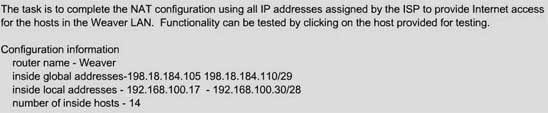

Solution:
The company has 14 hosts that need to access the internet simultaneously but we just have 6 public IP addresses from 198.18.184.105 to 198.18.184.110/29. Therefore we have to use NAT overload (or PAT)
Double click on the Weaver router to open it
Router>enable
Router#configure terminal
First you should change the router's name to Weaver
Router(config)#hostname Weaver
Create a NAT pool of global addresses to be allocated with their netmask.Weaver(config)#ip nat pool mypool 198.18.184.105 198.18.184.110 netmask 255.255.255.248
Create a standard access control list that permits the addresses that are to be translatedWeaver(config)#access-list 1 permit 192.168.100.16 0.0.0.15
Establish dynamic source translation, specifying the access list that was defined in the prior step
Weaver(config)#ip nat inside source list 1 pool mypool overload
This command translates all source addresses that pass access list 1, which means a source address from 192.168.100.17 to 192.168.100.30, into an address from the pool named mypool (the pool contains addresses from 198.18.184.105 to 198.18.184.110)
Overload keyword allows to map multiple IP addresses to a single registered IP address (many-to-one) by using different ports
The question said that appropriate interfaces have been configured for NAT inside and NAT outside statements.
This is how to configure the NAT inside and NAT outside, just for your understanding:
Weaver(config)#interface fa0/0
Weaver(config-if)#ip nat inside
Weaver(config-if)#exit
Weaver(config)#interface s0/0
Weaver(config-if)#ip nat outside
Weaver(config-if)#end
Finally, we should save all your work with the following command: Weaver#copy running-config startup-config
Check your configuration by going to "Host for testing" and type:
C:\>ping 192.0.2.114
The ping should work well and you will be replied from 192.0.2.114
Wednesday, September 9, 2009
CCNA2 Chapter 10 (NEW)
1 What action does a link-state router take immediately upon receipt of an LSP from a neighboring router?
• floods the LSP to neighbors
calculates the SPF algorithm
runs the Bellman-Ford algorithm
computes the best path to the destination network
2 Why is it difficult for routing loops to occur in networks that use link-state routing?
Each router builds a simple view of the network based on hop count.
Routers flood the network with LSAs to discover routing loops.
• Each router builds a complete and synchronized view of the network.
Routers use hold-down timers to prevent routing loops.
3

Refer to the exhibit. What kind of information would be seen in an LSP sent from router JAX to router ATL?
hop count
uptime of the route
• cost of the link
a list of all the routing protocols in use
4 To achieve network convergence, what three steps does each link state router take? (Choose three.)
use automatic summarization to reduce the size of routing tables
• build a Link State Packet (LSP) containing the state of each directly connected link
• flood the LSP to all neighbors, who then store all LSPs received in a database
discover neighbors and establish adjacencies using the hello packet sent at regular intervals
• construct a complete map of the topology and compute the best path to each destination network
use the DUAL FSM to select efficient, loop-free paths, and insert routes into the routing table
5

Refer to the exhibit. When Router D is configured to use a link-state routing protocol and is added to the network, what is the first thing that it does to begin learning the network topology?
It sends LSP packets to Routers B and C.
It sends LSP packets to all routers in the network.
It sends Hello packets to all routers in the network.
It sends information about its directly connected neighbors to Routers A and E.
It sends information about its directly connected neighbors to all routers in the network.
• It learns about its directly connected networks when its interfaces reach the up state.
6 A new network administrator is given the task of selecting an appropriate dynamic routing protocol for a software development company. The company has over 100 routers, uses CIDR and VLSM, requires fast convergence, and uses both Cisco and non-Cisco equipment. Which routing protocol is appropriate for this company?
RIP version 2
IGRP
EIGRP
• OSPF
BGP
7 What two events will cause a link state router to send LSPs to all neighbors? (Choose two.)
30 second timer expires
• whenever the network topology changes
immediately after the Bellman-Ford algorithm has run
immediately after the DUAL FSM has built the topology database
• upon initial startup of router or routing protocol
8 What is the final step in the link state routing process?
successors are placed into the routing table
• SPF computes best path to each destination network
LSPs are flooded to all neighbors to converge the network
DUAL algorithm is run to find best path to destination networks
9

Refer to the exhibit. What does JAX do with link-state packets from ORL?
sends out its updated routing table to both ORL and BOS routers
• sends out the individual link-state packets out the interface connected to BOS
queries BOS to see if it has a better route
only adds it to the local routing table and performs no other actions
10 What two statements correctly describe the link state routing process? (Choose two.)
• each router in the area floods LSPs to all neighbors
• all routers in the area have identical link state databases
LSPs use the reserved multicast address of 224.0.0.10 to reach neighbors
routing loops are prevented by running the Diffusing Update Algorithm (DUAL)
Reliable Transport Protocol (RTP) is the protocol used by for the delivery and reception of LSPs
11 Which database or table must be identical on all link-state routers within an area in order to construct an accurate SPF tree?
routing table
adjacency table
• link-state database
neighbor table
topology database
12

Refer to the exhibit. Which statement correctly describes the path traffic would take from the 10.0.0.0/24 network to the 192.168.1.0/24 network if a link-state routing protocol was in use?
BOS -> ATL because this path is the least hops
BOS -> ATL because this path is highest cost
• BOS -> ORL -> JAX -> ATL because this path is the lowest cost
traffic would load balance across all links
13 What feature do modern link-state protocols provide to minimize processing and memory requirements?
• splitting routing topologies into smaller areas
assigning lower process priorities to route calculations
using update timers to restrict routing updates
strict split horizon rules to reduce routing table entries
14 What speeds up convergence in a network using link-state routing?
• updates triggered by network changes
updates sent at regular intervals
updates sent only to directly connected neighbors
updates that include complete routing tables
15 Which algorithm is run by link-state routing protocols to calculate the shortest path to destination networks?
DUAL
• Dijkstra
Bellman-Ford
Diffie-Hellman
16 What are some of the advantages of using a link-state routing protocol instead of a distance vector routing protocol? (Choose two.)
The topology database eliminates the need for a routing table.
Frequent periodic updates are sent to minimize the number of incorrect routes in the topological database.
• Routers have direct knowledge of all links in the network and how they are connected.
• After the inital LSA flooding, they generally require less bandwidth to communicate changes in a topology.
Link-state protocols require less router processor power than distance vector protocols.
17

Refer to the exhibit. If all routers and interfaces are configured to use a link-state routing protocol, from which routers will router D receive hello packets?
A and E
• B and C
A, B, C, and E
C only
18 Which two routing protocols use Dijkstra’s shortest path first algorithm? (Choose two.)
RIPv1
RIPv2
• IS-IS
BGP
EIGRP
• OSPF
19 When are link-state packets sent to neighbors?
every 30 seconds
every 180 seconds
after the holddown time expires
• when a link goes up or down
when a routing loop occurs
• floods the LSP to neighbors
calculates the SPF algorithm
runs the Bellman-Ford algorithm
computes the best path to the destination network
2 Why is it difficult for routing loops to occur in networks that use link-state routing?
Each router builds a simple view of the network based on hop count.
Routers flood the network with LSAs to discover routing loops.
• Each router builds a complete and synchronized view of the network.
Routers use hold-down timers to prevent routing loops.
3

Refer to the exhibit. What kind of information would be seen in an LSP sent from router JAX to router ATL?
hop count
uptime of the route
• cost of the link
a list of all the routing protocols in use
4 To achieve network convergence, what three steps does each link state router take? (Choose three.)
use automatic summarization to reduce the size of routing tables
• build a Link State Packet (LSP) containing the state of each directly connected link
• flood the LSP to all neighbors, who then store all LSPs received in a database
discover neighbors and establish adjacencies using the hello packet sent at regular intervals
• construct a complete map of the topology and compute the best path to each destination network
use the DUAL FSM to select efficient, loop-free paths, and insert routes into the routing table
5

Refer to the exhibit. When Router D is configured to use a link-state routing protocol and is added to the network, what is the first thing that it does to begin learning the network topology?
It sends LSP packets to Routers B and C.
It sends LSP packets to all routers in the network.
It sends Hello packets to all routers in the network.
It sends information about its directly connected neighbors to Routers A and E.
It sends information about its directly connected neighbors to all routers in the network.
• It learns about its directly connected networks when its interfaces reach the up state.
6 A new network administrator is given the task of selecting an appropriate dynamic routing protocol for a software development company. The company has over 100 routers, uses CIDR and VLSM, requires fast convergence, and uses both Cisco and non-Cisco equipment. Which routing protocol is appropriate for this company?
RIP version 2
IGRP
EIGRP
• OSPF
BGP
7 What two events will cause a link state router to send LSPs to all neighbors? (Choose two.)
30 second timer expires
• whenever the network topology changes
immediately after the Bellman-Ford algorithm has run
immediately after the DUAL FSM has built the topology database
• upon initial startup of router or routing protocol
8 What is the final step in the link state routing process?
successors are placed into the routing table
• SPF computes best path to each destination network
LSPs are flooded to all neighbors to converge the network
DUAL algorithm is run to find best path to destination networks
9

Refer to the exhibit. What does JAX do with link-state packets from ORL?
sends out its updated routing table to both ORL and BOS routers
• sends out the individual link-state packets out the interface connected to BOS
queries BOS to see if it has a better route
only adds it to the local routing table and performs no other actions
10 What two statements correctly describe the link state routing process? (Choose two.)
• each router in the area floods LSPs to all neighbors
• all routers in the area have identical link state databases
LSPs use the reserved multicast address of 224.0.0.10 to reach neighbors
routing loops are prevented by running the Diffusing Update Algorithm (DUAL)
Reliable Transport Protocol (RTP) is the protocol used by for the delivery and reception of LSPs
11 Which database or table must be identical on all link-state routers within an area in order to construct an accurate SPF tree?
routing table
adjacency table
• link-state database
neighbor table
topology database
12

Refer to the exhibit. Which statement correctly describes the path traffic would take from the 10.0.0.0/24 network to the 192.168.1.0/24 network if a link-state routing protocol was in use?
BOS -> ATL because this path is the least hops
BOS -> ATL because this path is highest cost
• BOS -> ORL -> JAX -> ATL because this path is the lowest cost
traffic would load balance across all links
13 What feature do modern link-state protocols provide to minimize processing and memory requirements?
• splitting routing topologies into smaller areas
assigning lower process priorities to route calculations
using update timers to restrict routing updates
strict split horizon rules to reduce routing table entries
14 What speeds up convergence in a network using link-state routing?
• updates triggered by network changes
updates sent at regular intervals
updates sent only to directly connected neighbors
updates that include complete routing tables
15 Which algorithm is run by link-state routing protocols to calculate the shortest path to destination networks?
DUAL
• Dijkstra
Bellman-Ford
Diffie-Hellman
16 What are some of the advantages of using a link-state routing protocol instead of a distance vector routing protocol? (Choose two.)
The topology database eliminates the need for a routing table.
Frequent periodic updates are sent to minimize the number of incorrect routes in the topological database.
• Routers have direct knowledge of all links in the network and how they are connected.
• After the inital LSA flooding, they generally require less bandwidth to communicate changes in a topology.
Link-state protocols require less router processor power than distance vector protocols.
17

Refer to the exhibit. If all routers and interfaces are configured to use a link-state routing protocol, from which routers will router D receive hello packets?
A and E
• B and C
A, B, C, and E
C only
18 Which two routing protocols use Dijkstra’s shortest path first algorithm? (Choose two.)
RIPv1
RIPv2
• IS-IS
BGP
EIGRP
• OSPF
19 When are link-state packets sent to neighbors?
every 30 seconds
every 180 seconds
after the holddown time expires
• when a link goes up or down
when a routing loop occurs
Tuesday, September 8, 2009
CCNA2 Chapter 9 (new)
1 What two actions will the EIGRP DUAL FSM take if a link to a network goes down? (Choose two.)
put the route into passive mode
*query neighbors for a new route
search routing table for a feasible successor
run the SPF algorithm to find a new successor
*search topology table for a feasible successor
2

Host 192.168.1.66 in the network illustrated is unable to ping host 192.168.1.130. How must EIGRP be configured to
enable connectivity between the two hosts? (Choose two.)
R1(config-router)# network 192.168.1.128
R1(config-router)# auto-summary
* R1(config-router)# no auto-summary
* R2(config-router)# no auto-summary
R2(config-router)# auto-summary
R2(config-router)# network 192.168.1.64
3

Refer to the exhibit. The company is using EIGRP with an autonomous system number of 10. Pings between
hosts on networks that are connected to router A and those that are connected to router B are successful.
However, users on the 192.168.3.0 network are unable to reach users on the 192.168.1.32 network. What is the
most likely cause of this problem?
IP classless is enabled and is causing the packet to drop.
*The command network 192.168.1.32 was not issued on router C.
The routers are not configured in the same EIGRP routing domain.
Automatic summarization of the networks is causing the subnetted routes to be dropped.
4
What information is maintained in the EIGRP topology database for a destination route? (Choose three.)
*the routing protocol
*the feasible distance of the route
the highest cost of the route
the SRTT value for the route
*the route cost as advertised by the neighboring router
the physical address of the gateway interface
5
On a router running EIGRP, what database would maintain a list of feasible successors?
routing table
neighbor table
*topology table
adjacency table
6

Refer to the exhibit. What is indicated by the P at the beginning of the topology entry?
*the route is in a stable state
the route is a preferred route
DUAL is searching for a better route to this destination
the exit interface is in passive mode and EIGRP advertisements are blocked
7
In the command router eigrp 20, what is the purpose of the number 20?
specifies the administrative distance for all EIGRP routes
*identifies the autonomous system number this EIGRP process will advertise
determines what metric is added to all advertised routes
indicates the number of addresses in the EIGRP routing domain
8

Refer to the exhibit. In the topology table, what do the numbers 3011840 and 3128695 represent?
the route metric that is applied to those EIGRP routes for this router
the trustworthiness of the routing information source
the composite of the hop count and bandwidth to that destination network
*the total metric for that network as advertised by the EIGRP neighbor
9 Which two statements describe characteristics of EIGRP? (Choose two.)
*EIGRP is a distance vector routing protocol.
*EIGRP supports classless routing and VLSM.
EIGRP is classified as a link-state routing protocol.
EIGRP uses TCP for reliable delivery of EIGRP update packets.
With EIGRP, loop-free paths are achieved through the use of hold-down timers.
EIGRP sends a periodic update every 30 minutes.
10

Refer to the exhibit. Network 192.168.0.0/28 goes down. What type of packet does Router2 immediately send
to Router1 and Router3?
a query for network 192.168.0.0/28
an acknowledgment packet to 224.0.0.9
an update packet that is sent to 255.255.255.255
a packet that contains the new routing table for R2
*unicast update packets to 192.168.1.1 and 192.168.2.1
11

Refer to the exhibit. Which command will advertise the 192.168.1.64/30 network but not the 192.168.1.32
network on router A?
network 192.168.1.0
network 192.168.1.0 255.255.255.0
network 192.168.1.64 0.0.0.3
*network 192.168.1.64 0.0.0.7
network 192.168.1.64 0.0.0.255
12 What administrative distance would a router assign to a default route in EIGRP that is learned from a source
external to the autonomous system?
1
5
70
90
*170
190
13 In which of the following tables does the EIGRP DUAL algorithm store the primary route to a destination?
(Choose two.)
*routing
*topology
neighbor
path
shortest path
14 Which of the following types of routes will be denoted by EX in EIGRP routing table entries? (Choose two.)
*routes learned from other routing protocols
routes learned from any non-adjacent EIGRP routers
any route with a hop count metric higher than 224
*EIGRP routes that originate in different autonomous systems
all passive routes in the routing table
15 Which term defines a collection of networks under the administrative control of a single entity that presents a
common routing policy to the Internet?
*autonomous system
contiguous networks
process ID
BGP
16

Refer to the exhibit. EIGRP is the only routing protocol enabled on this network. No static routes are c
on this router. What can be concluded about network 198.18.1.0/24 from the exhibited output?
A route to network 198.18.1.0/24 is not listed in the routing table.
*Packets that are destined for 198.18.1.0/24 will be forwarded to 198.18.10.6.
EIGRP will perform equal cost load balancing across two paths when forwarding packets to 198.18
17

The router with interface 172.16.3.2 is a successor for network 198.18.1.0/24.
Refer to the exhibit. All interfaces have been configured with the bandwidths that are shown in the example
Assuming that all routers are using a default configuration of EIGRP as their routing protocol, what
packets take from the 172.16.1.0/16 network to the 192.168.200.0/24 network?
*A,B,E
A,C,E
A,D,E
Packets will load balance across the A,B,E and A,C,E paths.
Packets will load balance across the A,B,E and A,D,E paths.
Packets will load balance across the A,C,E and A,D,E paths.
18
By default, which two metrics are used by EIGRP to determine the best path between networks?
MTU
load
*delay
*bandwidth
reliability
19
Which of the following statements describes the bounded updates used by EIGRP?
Bounded updates are sent to all routers within an autonomous system.
*Partial updates are sent only to routers that need the information.
The updates are sent to all routers in the routing table.
Updates are bounded by the routers in the topology table.
20
The show ip eigrp topology command output on a router displays a successor route and a feasible successor
route to network 192.168.1.0/24. In order to reduce processor utilization, what does EIGRP do when the
primary route to this network fails?
The router sends query packets to all EIGRP neighbors for a better route to network 192.168.1.0/24.
The DUAL FSM immediately recomputes the algorithm to calculate the next backup route.
Packets that are destined for network 192.168.1.0/24 are sent out the default gateway instead.
*The backup route to network 192.168.1.0/24 is installed in the routing table.
21

Refer to the exhibit. Based on the output of show ip eigrp neighbors, what are two possible problems with
adjacencies between Router1 and Router2? (Choose two.)
*The routers are configured with different EIGRP process IDs.
Automatic summarization was disabled.
The hello timer for R1 was altered.
*The serial interfaces for both routers are in different networks.
No feasible successors were found.
22

Refer to the exhibit. This is the debug output from 2 directly connected EIGRP routers. They are not
forming an adjacency. What is the cause?
one router is a non-cisco router
* they have different autonomous-system numbers
they are using difference sequence numbers
they are sending incorrect hello types
put the route into passive mode
*query neighbors for a new route
search routing table for a feasible successor
run the SPF algorithm to find a new successor
*search topology table for a feasible successor
2

enable connectivity between the two hosts? (Choose two.)
R1(config-router)# network 192.168.1.128
R1(config-router)# auto-summary
* R1(config-router)# no auto-summary
* R2(config-router)# no auto-summary
R2(config-router)# auto-summary
R2(config-router)# network 192.168.1.64
3

Refer to the exhibit. The company is using EIGRP with an autonomous system number of 10. Pings between
hosts on networks that are connected to router A and those that are connected to router B are successful.
However, users on the 192.168.3.0 network are unable to reach users on the 192.168.1.32 network. What is the
most likely cause of this problem?
IP classless is enabled and is causing the packet to drop.
*The command network 192.168.1.32 was not issued on router C.
The routers are not configured in the same EIGRP routing domain.
Automatic summarization of the networks is causing the subnetted routes to be dropped.
4
What information is maintained in the EIGRP topology database for a destination route? (Choose three.)
*the routing protocol
*the feasible distance of the route
the highest cost of the route
the SRTT value for the route
*the route cost as advertised by the neighboring router
the physical address of the gateway interface
5
On a router running EIGRP, what database would maintain a list of feasible successors?
routing table
neighbor table
*topology table
adjacency table
6

Refer to the exhibit. What is indicated by the P at the beginning of the topology entry?
*the route is in a stable state
the route is a preferred route
DUAL is searching for a better route to this destination
the exit interface is in passive mode and EIGRP advertisements are blocked
7
In the command router eigrp 20, what is the purpose of the number 20?
specifies the administrative distance for all EIGRP routes
*identifies the autonomous system number this EIGRP process will advertise
determines what metric is added to all advertised routes
indicates the number of addresses in the EIGRP routing domain
8

Refer to the exhibit. In the topology table, what do the numbers 3011840 and 3128695 represent?
the route metric that is applied to those EIGRP routes for this router
the trustworthiness of the routing information source
the composite of the hop count and bandwidth to that destination network
*the total metric for that network as advertised by the EIGRP neighbor
9 Which two statements describe characteristics of EIGRP? (Choose two.)
*EIGRP is a distance vector routing protocol.
*EIGRP supports classless routing and VLSM.
EIGRP is classified as a link-state routing protocol.
EIGRP uses TCP for reliable delivery of EIGRP update packets.
With EIGRP, loop-free paths are achieved through the use of hold-down timers.
EIGRP sends a periodic update every 30 minutes.
10

Refer to the exhibit. Network 192.168.0.0/28 goes down. What type of packet does Router2 immediately send
to Router1 and Router3?
a query for network 192.168.0.0/28
an acknowledgment packet to 224.0.0.9
an update packet that is sent to 255.255.255.255
a packet that contains the new routing table for R2
*unicast update packets to 192.168.1.1 and 192.168.2.1
11

Refer to the exhibit. Which command will advertise the 192.168.1.64/30 network but not the 192.168.1.32
network on router A?
network 192.168.1.0
network 192.168.1.0 255.255.255.0
network 192.168.1.64 0.0.0.3
*network 192.168.1.64 0.0.0.7
network 192.168.1.64 0.0.0.255
12 What administrative distance would a router assign to a default route in EIGRP that is learned from a source
external to the autonomous system?
1
5
70
90
*170
190
13 In which of the following tables does the EIGRP DUAL algorithm store the primary route to a destination?
(Choose two.)
*routing
*topology
neighbor
path
shortest path
14 Which of the following types of routes will be denoted by EX in EIGRP routing table entries? (Choose two.)
*routes learned from other routing protocols
routes learned from any non-adjacent EIGRP routers
any route with a hop count metric higher than 224
*EIGRP routes that originate in different autonomous systems
all passive routes in the routing table
15 Which term defines a collection of networks under the administrative control of a single entity that presents a
common routing policy to the Internet?
*autonomous system
contiguous networks
process ID
BGP
16

Refer to the exhibit. EIGRP is the only routing protocol enabled on this network. No static routes are c
on this router. What can be concluded about network 198.18.1.0/24 from the exhibited output?
A route to network 198.18.1.0/24 is not listed in the routing table.
*Packets that are destined for 198.18.1.0/24 will be forwarded to 198.18.10.6.
EIGRP will perform equal cost load balancing across two paths when forwarding packets to 198.18
17

The router with interface 172.16.3.2 is a successor for network 198.18.1.0/24.
Refer to the exhibit. All interfaces have been configured with the bandwidths that are shown in the example
Assuming that all routers are using a default configuration of EIGRP as their routing protocol, what
packets take from the 172.16.1.0/16 network to the 192.168.200.0/24 network?
*A,B,E
A,C,E
A,D,E
Packets will load balance across the A,B,E and A,C,E paths.
Packets will load balance across the A,B,E and A,D,E paths.
Packets will load balance across the A,C,E and A,D,E paths.
18
By default, which two metrics are used by EIGRP to determine the best path between networks?
MTU
load
*delay
*bandwidth
reliability
19
Which of the following statements describes the bounded updates used by EIGRP?
Bounded updates are sent to all routers within an autonomous system.
*Partial updates are sent only to routers that need the information.
The updates are sent to all routers in the routing table.
Updates are bounded by the routers in the topology table.
20
The show ip eigrp topology command output on a router displays a successor route and a feasible successor
route to network 192.168.1.0/24. In order to reduce processor utilization, what does EIGRP do when the
primary route to this network fails?
The router sends query packets to all EIGRP neighbors for a better route to network 192.168.1.0/24.
The DUAL FSM immediately recomputes the algorithm to calculate the next backup route.
Packets that are destined for network 192.168.1.0/24 are sent out the default gateway instead.
*The backup route to network 192.168.1.0/24 is installed in the routing table.
21

Refer to the exhibit. Based on the output of show ip eigrp neighbors, what are two possible problems with
adjacencies between Router1 and Router2? (Choose two.)
*The routers are configured with different EIGRP process IDs.
Automatic summarization was disabled.
The hello timer for R1 was altered.
*The serial interfaces for both routers are in different networks.
No feasible successors were found.
22

Refer to the exhibit. This is the debug output from 2 directly connected EIGRP routers. They are not
forming an adjacency. What is the cause?
one router is a non-cisco router
* they have different autonomous-system numbers
they are using difference sequence numbers
they are sending incorrect hello types
Subscribe to:
Posts (Atom)